
KEMET
KEMET 0.011 uF 35 V Hermetically Sealed Axial Tantalum Capacitor, Lot 6702MJ
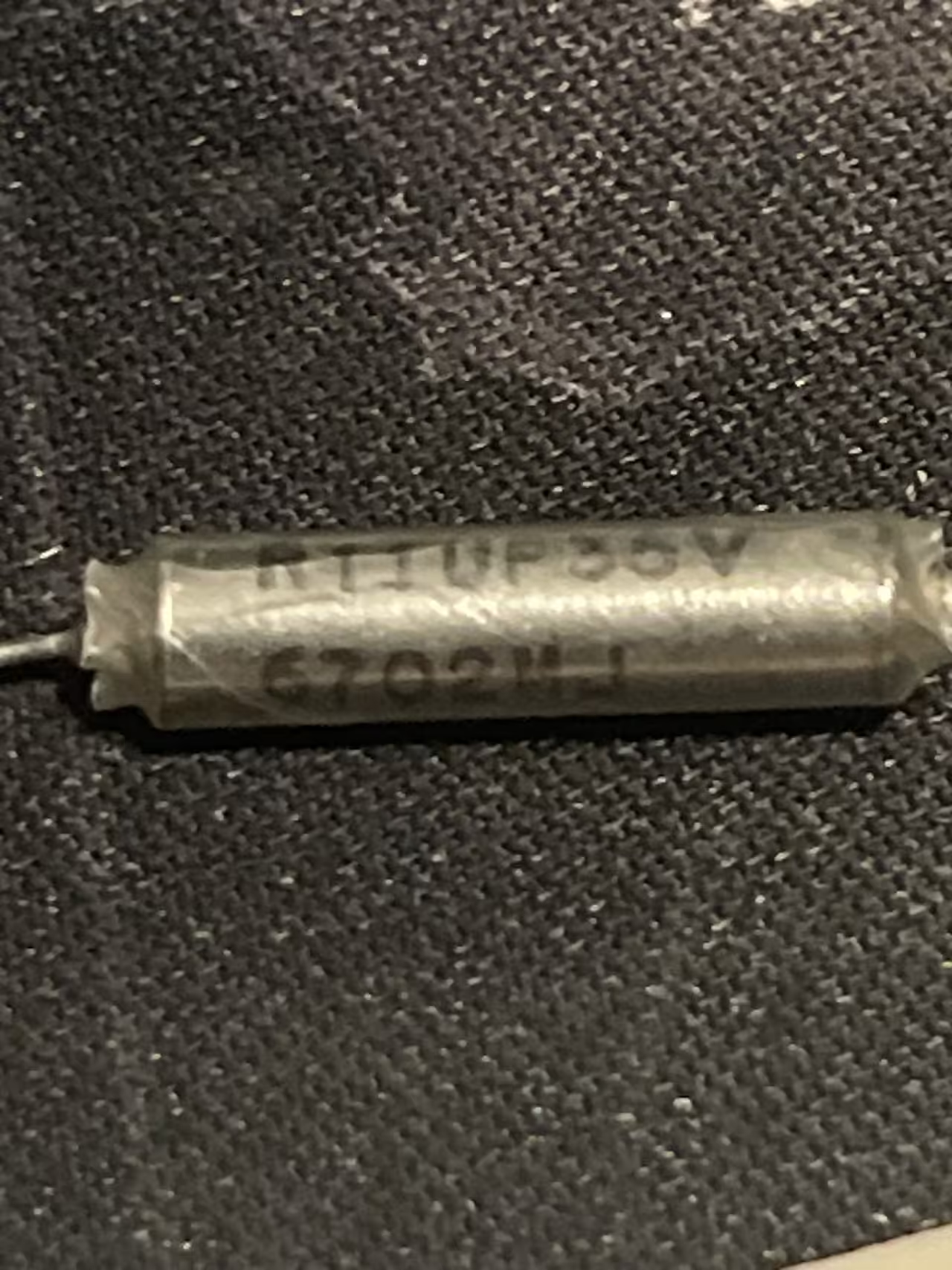
- 3 photos
Never used. The original pack has been opened, or the quantity was split off a full reel or tube. Leads are original and unclipped.
New old stock, open stock on the grading scaleSend the quantity you need. You get a quote back with shipping before anything is charged.
Videos
Filmed on the bench. Sound is stripped from product clips.
- 0:10
- 0:07
Specifications
| Specification | Value |
|---|---|
| Identification | |
| Part number | SBKD2HTJ |
| Manufacturer | KEMET |
| Condition | New old stock, open stock |
| Date code | Not recorded |
| Package | Hermetically sealed metal cylindrical case, axial wire leads |
| Country of origin | Not recorded |
| Family | Not recorded |
| Stock number | SBKD2HTJ |
| Electrical | |
| Capacitance | 0.011 uF, that is 11 nF or 11000 pF, printed on the case |
| DC voltage rating | 35 V, printed on the case |
| Dielectric | Tantalum |
| Polarity | Polarised. Reverse voltage can cause a short circuit failure |
| Not established | |
| Tolerance | Not printed on the case |
| Markings as read | |
| Marking, value line | .011UF 35V |
| Marking, lot line | 6702MJ |
| Marking, maker | KEMET, printed on a second face of the case |
| Physical | |
| Case | Hermetically sealed metal cylinder with glass to metal lead seals |
| Lead style | Axial, one long tinned wire lead from each end |
| Provenance | |
| Paperwork part number | Inventory paperwork gives a KEMET T111 series number whose capacitance and voltage fields match the case markings. Not printed on the part, so not listed as the part number |
| Manufacturer | KEMET, from the marking on the case |
| Quantity offered | One piece |
| Condition | New old stock, unused, leads full length and unsoldered |
| Basis of identification | The markings on the case. The series number comes from paperwork and is reported, not claimed |
| Overview | |
| Suggested use | Low leakage timing and filtering where stability and a sealed case matter more than bulk |
About this part
A KEMET hermetically sealed axial tantalum capacitor, 0.011 uF at 35 volts, lot 6702MJ. New old stock, long straight leads, never fitted.
The value is the interesting part. Eleven nanofarads is a very small number for a tantalum, and it is not what tantalums are usually bought for. The whole point of the chemistry is enormous capacitance in a small volume, which is why the everyday tantalum is measured in microfarads. A hermetic tantalum at 0.011 uF is not there for bulk at all: it is there because somebody needed a small, extremely stable, extremely low leakage capacitor that would survive a sealed environment and a wide temperature range, and was willing to pay for a metal cased military style part to get it.
The case is a hermetically sealed metal cylinder, welded rather than potted, with glass to metal seals at the lead exits. That construction is what separates this from the epoxy dipped tantalums most people have met. Nothing gets in and nothing gets out, so the electrolyte cannot dry and the part is unaffected by humidity, which is precisely why they were specified for aerospace and instrumentation.
Being a tantalum, it is polarised, and that matters more than it does with most capacitors. Reversing a tantalum does not merely degrade it. It can fail as a short circuit, which on a low impedance supply means heat, smoke and sometimes flame. Identify the positive end before fitting it.
Inventory paperwork with this part gives a KEMET T111 series number whose capacitance and voltage fields decode to exactly the 0.011 uF and 35 V printed on the case.
Questions about this part
Why would anyone want a tantalum at only 11 nanofarads?
Not for its capacitance, which is the point. Tantalum chemistry exists to pack a lot of capacitance into a small case, so a tantalum at 0.011 uF is being bought for its other properties: very low leakage, a stable value over temperature and time, and a hermetic case that survives humidity and altitude. That combination is why these turn up in instrumentation, aerospace and military equipment rather than in consumer gear.
What does hermetically sealed actually mean here?
The case is a metal cylinder closed by welding, with the leads brought out through glass to metal seals rather than through rubber or epoxy. It is a genuine gas tight enclosure. Nothing can get in and nothing can get out, so the internal chemistry cannot dry out and moisture cannot reach it. An epoxy dipped tantalum has none of that protection, which is why the two are priced so differently.
Which lead is positive?
Check the case marking before you fit it. Tantalums are polarised and the positive end is identified on the body, usually by a mark or by the printed layout. This matters more than with most capacitors, because reversing a tantalum can fail it as a dead short rather than simply degrading it. On a low impedance supply that means heat, smoke and sometimes flame.
Does a tantalum degrade sitting in a drawer?
A hermetic one, hardly at all. There is no seal to perish and no path for moisture, so the mechanisms that age a dipped part are absent. Unlike an aluminium electrolytic, a tantalum does not need reforming after storage. The realistic shelf risk is mechanical damage to the glass seals from rough handling, which would show as a cracked seal at a lead exit, and there is none here.
Should I derate it in service?
Yes, and by more than you might expect. Standard practice for solid tantalum is to run at about half the rated voltage, and to keep series resistance in the circuit on a low impedance supply so a fault cannot deliver unlimited current. Applied to this part, that means treating a 35 V capacitor as comfortable at about 17 volts in normal use.
What does the 6702MJ marking mean?
It reads as a lot or date code rather than an electrical parameter, and we have not matched it to a published KEMET scheme. It is recorded here exactly as it is printed rather than expanded into a manufacturing date we cannot support. If you recognise the format we would be glad to know.
What condition is this one in?
New old stock, open stock, never installed. The case is clean with no dents or corrosion, both glass seals are intact, the printing is legible and the leads are at full length, straight and unsoldered. The photographs show the actual capacitor you would receive.