
Small Moulded Mica Capacitor Marked 33C, Brown Body, Maker Not Identified
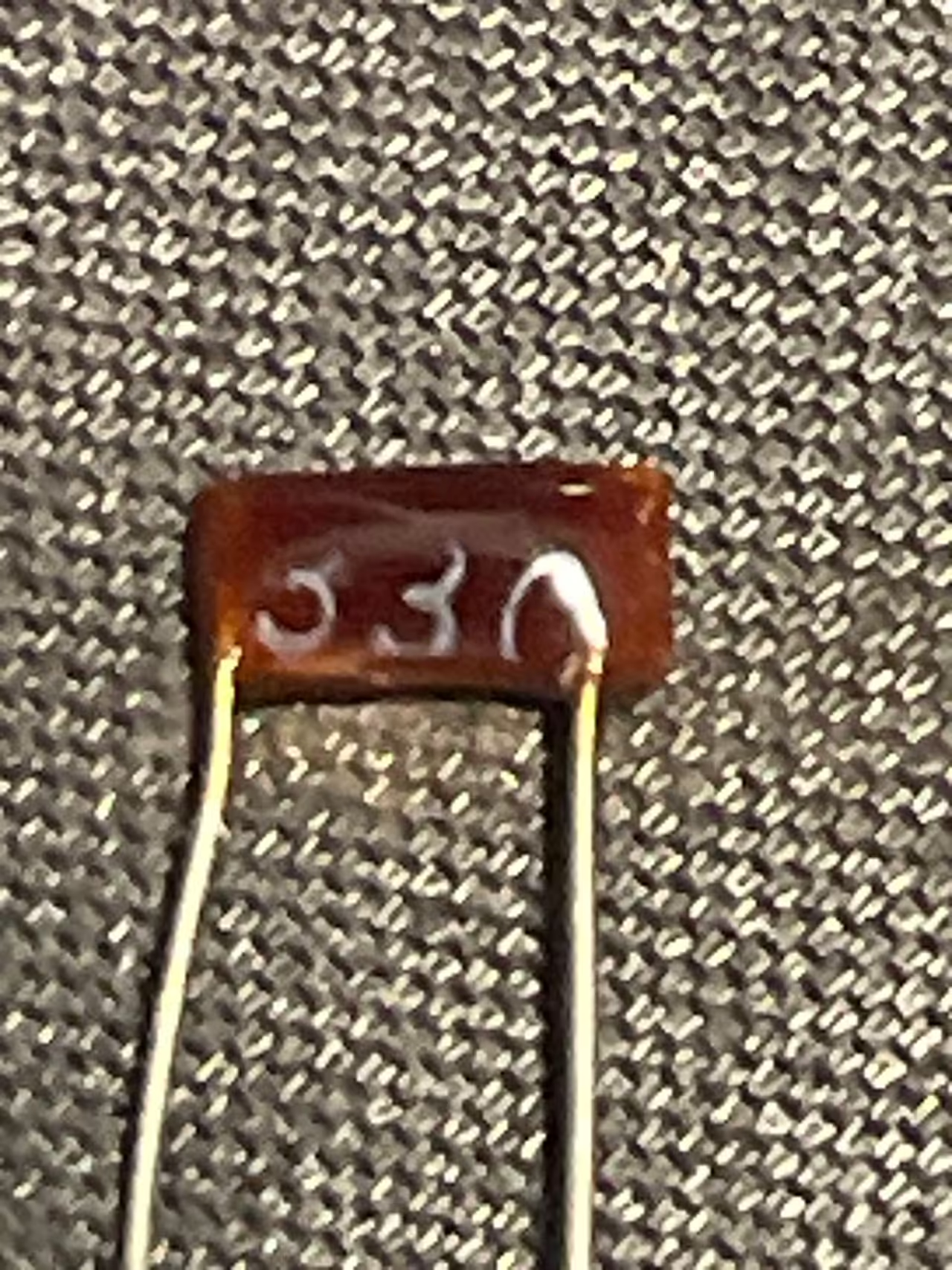
- 3 photos
Never used. The original pack has been opened, or the quantity was split off a full reel or tube. Leads are original and unclipped.
New old stock, open stock on the grading scaleSend the quantity you need. You get a quote back with shipping before anything is charged.
Video
Filmed on the bench. Sound is stripped from product clips.
- 0:06
Specifications
| Specification | Value |
|---|---|
| Identification | |
| Part number | SEQ2CW8R |
| Manufacturer | Not recorded |
| Condition | New old stock, open stock |
| Date code | Not recorded |
| Package | Small moulded rectangular mica case, radial leads |
| Country of origin | Not recorded |
| Family | Not recorded |
| Stock number | SEQ2CW8R |
| Overview | |
| Type | Moulded mica capacitor |
| Meaning of MMF | Micro microfarads, the older notation for picofarads. 33 MMF is 33 pF |
| Suggested use | Radio frequency tuning, oscillator trimming and coupling where a small stable value is needed |
| Note on stray capacitance | At 33 pF the capacitance of the surrounding wiring is a meaningful fraction of the total |
| Electrical | |
| Capacitance | 33 pF, consistent with the 33 printed on the body and the 33 MMF in the paperwork |
| Polarity | None. Mica capacitors are not polarised |
| Provenance | |
| DC voltage rating | 500 V, from the accompanying documentation rather than from the body |
| Quantity offered | One piece |
| Condition | New old stock, unused, case unchipped and leads unsoldered |
| Basis of identification | The printed 33 on the body, supported by the documented 33 MMF |
| Not established | |
| Tolerance | Not established. The trailing C has not been decoded |
| Manufacturer | Not identified. Neither face carries a maker's name or logo |
| Markings as read | |
| Marking, face 1 | 33C |
| Marking, face 2 | No printing |
| Physical | |
| Lead style | Radial, both leads from the same edge |
| Body | Small moulded rectangular case, brown, noticeably smaller than the 270 and 300 pF parts alongside it |
About this part
A small moulded mica capacitor with a brown body, marked 33C on one face and nothing on the other. New old stock, unused, leads straight and bright.
Inventory documentation with this part gives it as 33 MMF at 500 volts DC. MMF is the old notation for picofarads, micro microfarads, and it appears throughout American service literature of the valve era, so 33 MMF is 33 pF. That reading is consistent with the 33 printed on the body, and it is the value we would work to.
The trailing C is not decoded here, and it is worth saying why rather than picking a plausible expansion. In some makers' schemes a letter in that position is the characteristic, fixing the temperature coefficient and the permitted drift. In others it is a tolerance letter, and in others again it is a house code that means nothing outside the factory. Without a maker's name on the body there is no way to choose between those, so the marking is recorded exactly as printed and the tolerance field is left open.
Thirty three picofarads is a genuinely small capacitor and it lives in a specific place: radio frequency work, where it sets a resonance, trims an oscillator, couples an aerial stage or provides feedback in a tuned amplifier. At this value the capacitance of the wiring around it starts to matter, which is exactly why a stable dielectric like mica is used rather than a ceramic that shifts with temperature.
Questions about this part
What does MMF mean?
Micro microfarads, which is the older American notation for what everyone now calls picofarads. A millionth of a millionth of a farad. It appears constantly in service manuals and parts lists from the valve era, and it catches people out because it looks as though it should mean something larger. 33 MMF is simply 33 pF.
Why has the C not been decoded?
Because a letter in that position means different things to different makers, and this capacitor does not say who made it. For some it is the characteristic, which fixes the temperature coefficient and the permitted drift. For others it is a tolerance letter. For others it is a factory code with no external meaning. Choosing one of those and printing it would be a guess dressed as a specification, so we have recorded the marking as it is and left the tolerance field open.
What is 33 pF actually used for?
It is a radio frequency value. At this size a capacitor is setting a resonance rather than storing anything, so it turns up trimming an oscillator, tuning an intermediate frequency stage, coupling an aerial input or providing the feedback that keeps an oscillator running. You will not find it doing supply decoupling, because at 33 pF there is nothing to decouple with.
Why does the dielectric matter so much at this value?
Because the capacitance you fit is only part of the capacitance the circuit sees. At 33 pF, the few picofarads contributed by the wiring, the valve holder and the chassis are a significant fraction of the total. If the capacitor itself then drifts with temperature, as a class 2 ceramic does, the resonance moves audibly. Mica holds its value, which is why it was specified for this job.
How do I measure such a small value accurately?
Zero your meter with the test leads in place before you start, because the leads alone can contribute several picofarads and at 33 pF that is a ten percent error. Keep the leads short and do not hold the capacitor body in your fingers while measuring, since your hand adds capacitance too. Anything between roughly 30 and 36 pF would be entirely normal for a part of this era.
Does it need any conditioning before use?
None. Mica is a mineral dielectric and it has no electrolyte to dry, no oxide layer to reform and no seal to perish. It can be fitted straight from the drawer. That is the opposite of an electrolytic of the same age, which needs bringing up slowly if it is worth using at all.
What condition is this one in?
New old stock, open stock, never fitted. The small moulded case is intact with no chips or cracks, the 33C marking is legible, and both leads are bright, straight and unsoldered. The photographs show the actual capacitor you would receive.