
Orange Dipped Axial Capacitor, 0.1 uF 50 V, Circled 2 Mark, Maker Not Identified
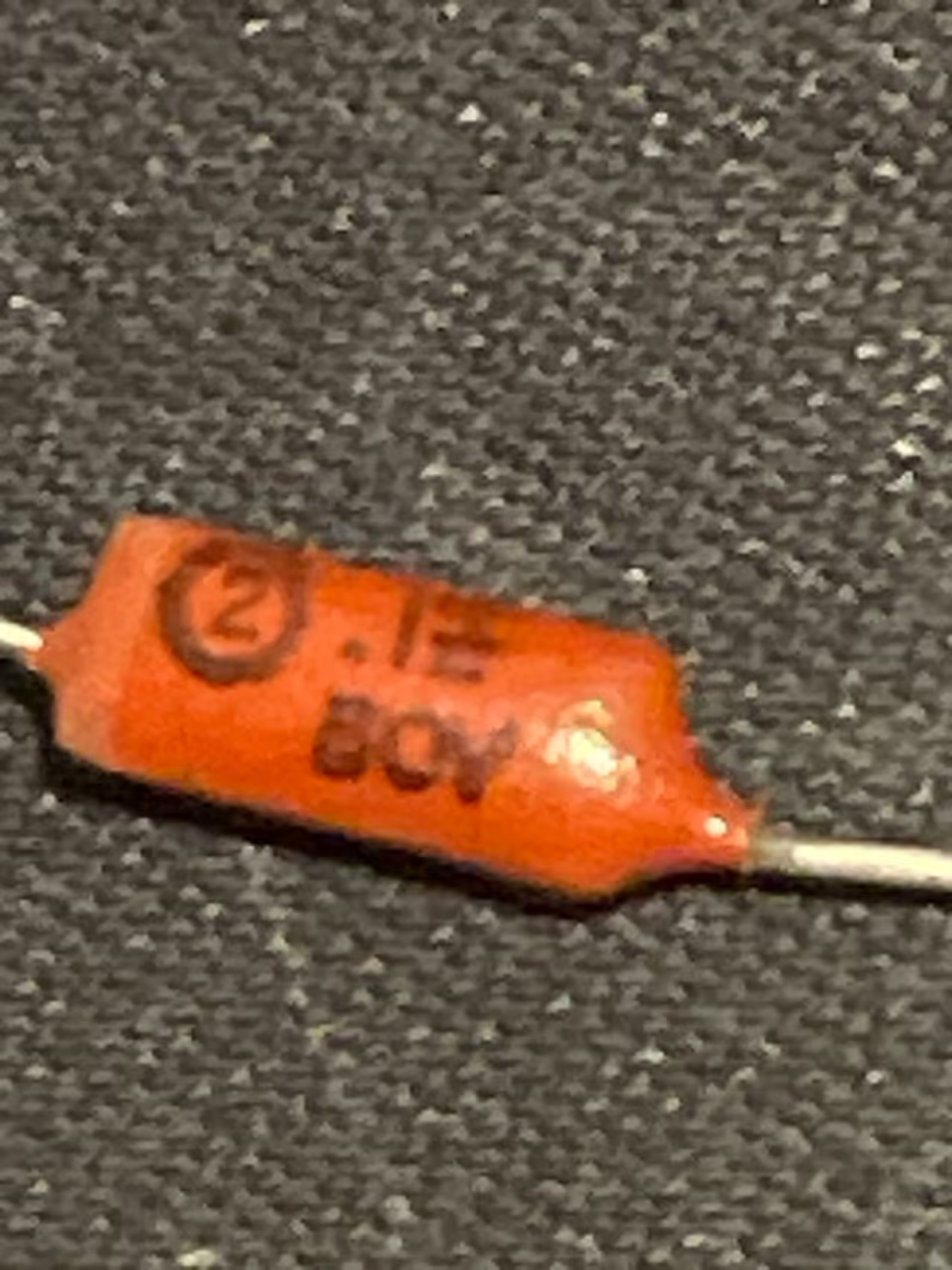
- 2 photos
Never used. The original pack has been opened, or the quantity was split off a full reel or tube. Leads are original and unclipped.
New old stock, open stock on the grading scaleSend the quantity you need. You get a quote back with shipping before anything is charged.
Video
Filmed on the bench. Sound is stripped from product clips.
- 0:12
Specifications
| Specification | Value |
|---|---|
| Identification | |
| Part number | SB7S4VCY |
| Manufacturer | Not recorded |
| Condition | New old stock, open stock |
| Date code | Not recorded |
| Package | Dipped axial, tapered orange body, two tinned wire leads |
| Country of origin | Not recorded |
| Family | Not recorded |
| Stock number | SB7S4VCY |
| Electrical | |
| Capacitance | 0.1 uF, printed on the body |
| DC voltage rating | 50 V, printed on the body |
| Polarity | None. No stripe, no plus mark, not an electrolytic |
| Not established | |
| Tolerance | Not established. No tolerance letter is printed |
| Dielectric | Not established. The dipped tubular form is consistent with moulded film or tubular ceramic |
| Manufacturer | Not identified. No maker's name or type number appears on the body |
| Markings as read | |
| Marking, value line | A digit 2 inside a printed circle, then .1 |
| Marking, voltage line | 50V |
| Physical | |
| Lead style | Axial, one tinned wire lead from each end |
| Body | Dipped orange coating, tapered toward each lead exit |
| Provenance | |
| Note on the paperwork | Inventory paperwork names a Sprague electrolytic series number that is not on the part and does not match its construction. Not used in this listing |
| Shared marking | The circled 2 also appears on two other capacitors from the same source |
| Condition | New old stock, unused, leads unsoldered |
| Quantity offered | One piece |
| Basis of identification | The printed value and voltage only. Nothing here rests on the handwriting |
| Overview | |
| Suggested use | Coupling, bypass and supply decoupling in signal level circuits |
About this part
A small orange dipped axial capacitor marked with a digit 2 inside a printed circle, then the value 0.1, and 50V on the line below. New old stock, unused, leads straight.
The electrical facts are on the body and they are the two a buyer needs: 0.1 uF at 50 volts DC. That is the workhorse value of analogue electronics, the one that sits across a supply pin, couples a stage or bypasses a cathode, and 50 V is ample for signal level work in valve and transistor equipment alike.
What is not on the body is a maker's name or a type number. The inventory paperwork that came with this part carries a Sprague series number, but that number does not appear anywhere on the capacitor, and the series it names is an aluminium electrolytic line, which this plainly is not: there is no polarity mark, no stripe, no crimped can and no vent. We have therefore left the manufacturer field empty rather than repeat a number the part does not carry. Saying nothing is better than saying something a buyer would find contradicted the moment it arrived.
The circled 2 is worth recording because it is not unique to this part. Two other capacitors from the same shelf carry the same mark, and one of those is identified as a Sprague by its own printed type designation. That makes a house or inspection mark a plausible reading of the circle, but a shared glyph across three parts is evidence about a shelf and not a name on this body.
The tapered dipped form and the orange coating are consistent with a moulded film or a tubular ceramic. Without a type number we are not going to choose between them in a spec row.
Questions about this part
Why is the manufacturer field empty when the paperwork names one?
Because the paperwork and the part disagree. The inventory note gives a Sprague series number, but that number is nowhere on the body, and the series it names is an aluminium electrolytic line. This capacitor has no polarity mark, no stripe, no crimped can and no vent, so it is not an electrolytic of any kind. Rather than print a maker we cannot support, we list what the body says and leave the rest empty.
What is the circled 2?
Most likely a plant, line or inspection mark rather than anything about this part specifically. It is worth mentioning because two other capacitors from the same shelf carry the same circled 2, and one of those is identified as a Sprague by its own printed type designation. That makes a house mark a more plausible reading than it was, but three parts sharing a glyph tells you about a shelf, not about a maker, so it puts no name on this body.
Is 0.1 uF at 50 V useful?
It is probably the single most useful small capacitor value there is. It couples one stage to the next, bypasses a cathode or an emitter, and decouples a supply pin close to the device it feeds. Fifty volts is comfortable for signal level work and for the low voltage rails in most transistor equipment. It is not a mains part and must not be used as one.
Can I use it where the original was a film capacitor?
Probably, but check what the circuit depends on. If it is doing bypass or coupling duty, almost any 0.1 uF at adequate voltage will do the job and nobody will hear a difference. If it sits in a filter or a time constant the dielectric matters, because a class 2 ceramic loses capacitance under DC bias and drifts with temperature while a film does not. Measure it under circuit conditions if the value has to hold.
How do I work out the dielectric myself?
Measure the capacitance, then warm the body gently and measure again, then measure with a few volts of DC bias across it. Film stays put through both. A class 2 ceramic moves noticeably with temperature and drops under bias. It takes two minutes with a meter that can measure capacitance and it settles the question better than we can from a photograph.
Will it have degraded in storage?
Whichever dielectric it is, no. Film and ceramic both sit indefinitely without change, unlike an electrolytic which dries out and wants reforming. Nothing here needs waking up. The only shelf ageing that matters is on the lead surfaces, and these are bright and take solder.
What condition is this one in?
New old stock, open stock. Never fitted and never soldered. The dipped coating is unchipped, the printing is legible, and both leads are straight and clean. The photographs show the actual capacitor you would receive.