
Ceramic Disc Capacitor Marked X5F 1KV, 30 pF at 1000 V, Maker Not Identified
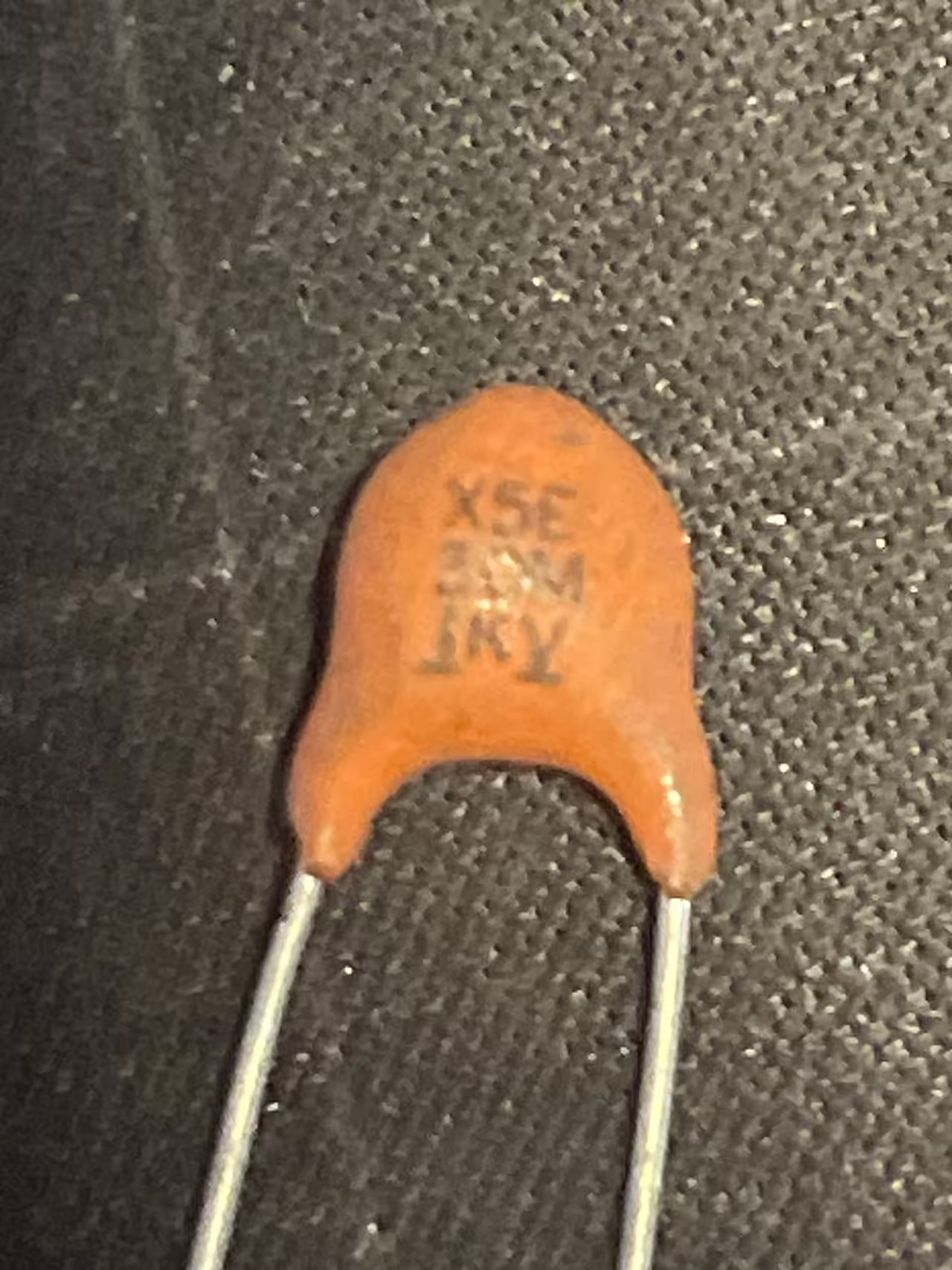
- 2 photos
Never used. The original pack has been opened, or the quantity was split off a full reel or tube. Leads are original and unclipped.
New old stock, open stock on the grading scaleSend the quantity you need. You get a quote back with shipping before anything is charged.
Video
Filmed on the bench. Sound is stripped from product clips.
- 0:21
Specifications
| Specification | Value |
|---|---|
| Identification | |
| Part number | VWF3VFY8 |
| Manufacturer | Not recorded |
| Condition | New old stock, open stock |
| Date code | Not recorded |
| Package | Radial ceramic disc, dipped orange coating, two tinned leads |
| Country of origin | Not recorded |
| Family | Not recorded |
| Stock number | VWF3VFY8 |
| Electrical | |
| Capacitance | 30 pF, recorded at capture with the part in hand |
| Tolerance | Plus or minus 20 percent, from the M code |
| DC voltage rating | 1000 V, printed as 1KV |
| Temperature characteristic | X5F, specified from minus 55 to plus 85 degrees Celsius |
| Dielectric class | Class 2 ceramic, from the X5F designation |
| Polarity | None. Ceramic capacitors are not polarised |
| Not established | |
| Value legibility | The printed digit reads as 30 or 35 in the photographs and cannot be settled from them. Measure to confirm |
| Manufacturer | Not identified. No maker's name or logo appears on the body |
| Markings as read | |
| Marking, line 1 | X5F |
| Marking, line 2 | A two digit value followed by M |
| Marking, line 3 | 1KV |
| Physical | |
| Lead style | Radial, both leads from the same edge of the disc |
| Body | Dipped orange coating over a ceramic disc |
| Provenance | |
| Quantity offered | One piece |
| Condition | New old stock, unused, coating intact and leads unsoldered |
| Overview | |
| Suggested use | High voltage bypass, snubbing and coupling in valve and high tension equipment |
About this part
An orange ceramic disc capacitor marked on three lines: X5F, then a two digit value with the tolerance letter M, then 1KV. New old stock, unused.
The kilovolt is what makes this worth having. A small value at a thousand volts is a specific component with a specific job: across points, snubbing a transformer, coupling where several hundred volts of DC sit on the capacitor before any signal arrives, or bypassing an anode supply in valve equipment. The same capacitance rated at 50 volts is an everyday item; rated at 1 kV it is not.
X5F is the temperature characteristic and it is the most informative marking on the body. It says the capacitance is specified between minus 55 and plus 85 degrees Celsius and holds to within a defined percentage across that span. That matters because it tells you this is a class 2 ceramic with a stated envelope rather than an unspecified general purpose part, and it tells you the value will move somewhat with temperature and under DC bias.
ONE HONEST CAVEAT ON THE VALUE. The middle line reads as 30 or 35 picofarads and the photographs will not settle which, even magnified and contrast stretched. The operator recorded 30 with the part in his hand, which is better evidence than a photograph, so 30 pF is what is listed. It is a few picofarads either way and it takes one measurement to confirm, but if the exact value matters to your circuit, measure it on arrival rather than trusting the listing.
Questions about this part
Is it 30 pF or 35 pF?
Recorded as 30, and we want to be straight about how confident that is. The middle line of the marking reads as either in the photographs, and magnifying and contrast stretching them did not settle it, which is the same technique that resolved markings on several other parts in this catalogue. The 30 comes from the operator reading the part in his hand, which is better evidence than any photograph, so that is what is listed. Measure it on arrival if a few picofarads matter to you.
What does X5F tell me?
It is the temperature characteristic, and it is the most useful marking on the body. X means the lower limit is minus 55 degrees Celsius, 5 means the upper limit is plus 85, and F specifies how much the capacitance may move across that span. It identifies this as a class 2 ceramic with a stated envelope rather than an unspecified general purpose part, which is worth knowing before you rely on the value.
Why does the 1 kV rating matter?
Because it is what makes a small value capacitor a specific component rather than a commodity. Thirty picofarads is available in a hundred forms, nearly all of them rated at 50 or 100 volts. A disc that will hold off a kilovolt has a much thicker dielectric and belongs where high voltage sits across it: across points, snubbing a transformer, bypassing an anode supply, or coupling a stage that carries several hundred volts of standing DC.
Will the value hold in service?
Approximately, not precisely. X5F is a class 2 dielectric, which means the capacitance moves with temperature within the specified envelope and also falls under DC bias, and on a part that may be sitting at several hundred volts the bias effect is not small. If it is doing bypass or snubber duty that does not matter at all. If it is setting a resonance, measure it under working conditions rather than trusting the printed number.
Can I use it well below 1000 volts?
Yes, freely. A capacitor is never harmed by running under its rating, and high voltage parts are often chosen at low voltage precisely for the margin. Two things to expect: the disc is physically larger than a low voltage part of the same value, so it may not fit where the original did, and a class 2 ceramic actually behaves better at a small fraction of its rating, since the bias effect is smaller.
Is a 20 percent tolerance a problem at this value?
It depends on the job. For bypass or snubbing, no. For a tuned circuit at 30 pF, 20 percent is six picofarads, which is a meaningful shift in resonance, and you would want a mica or a class 1 ceramic instead. This catalogue lists precision micas in that value range for exactly that reason.
What condition is this one in?
New old stock, open stock, never fitted. The dipped coating is intact with no chips or cracks, the printing is legible apart from the ambiguity in the value digit noted above, and both leads are straight and unsoldered. The photographs show the actual capacitor you would receive.