
A single Ceramic Disc Capacitors Marked CM 1M 1KV E, 1000 pF at 1000 V, Two Available
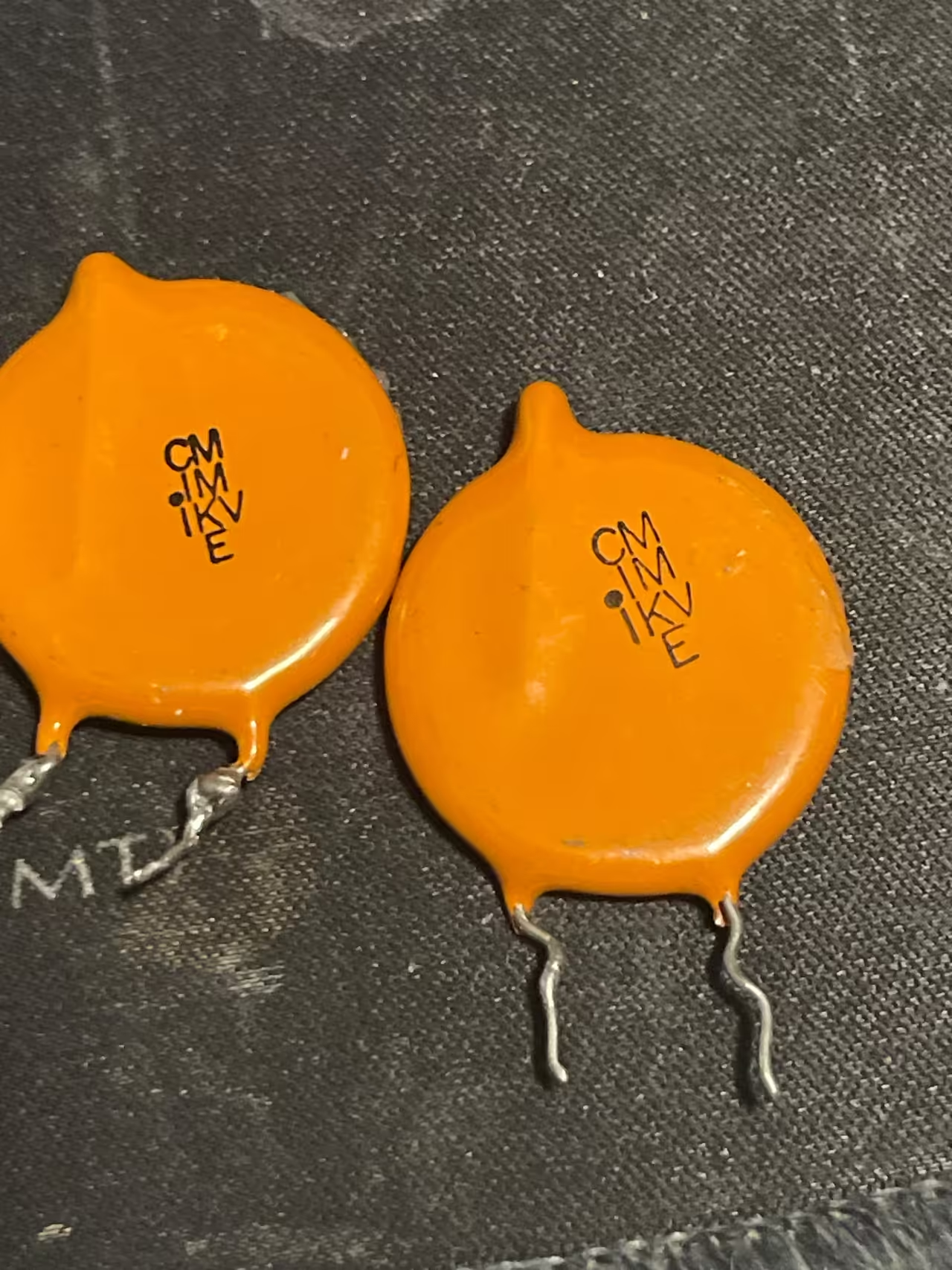
- 3 photos
Never used. The original pack has been opened, or the quantity was split off a full reel or tube. Leads are original and unclipped.
New old stock, open stock on the grading scaleSend the quantity you need. You get a quote back with shipping before anything is charged.
Video
Filmed on the bench. Sound is stripped from product clips.
- 0:17
Specifications
| Specification | Value |
|---|---|
| Identification | |
| Part number | SD787B9G |
| Manufacturer | Not recorded |
| Condition | New old stock, open stock |
| Date code | Not recorded |
| Package | Radial ceramic disc, dipped orange coating, two tinned leads |
| Country of origin | Not recorded |
| Family | Not recorded |
| Stock number | SD787B9G |
| Electrical | |
| Capacitance | 1000 pF, that is 1 nF or 0.001 uF |
| DC voltage rating | 1000 V, printed as 1KV |
| Polarity | None. Ceramic capacitors are not polarised |
| Not established | |
| Tolerance | Not established. The M may be a tolerance letter or part of the value code |
| Dielectric | Ceramic disc. Class not established, no temperature characteristic code is printed |
| Manufacturer | Not identified. No maker's name or logo appears on either disc |
| Markings as read | |
| Marking, line 1 | CM |
| Marking, line 2 | 1M |
| Marking, line 3 | 1KV |
| Marking, line 4 | E |
| Physical | |
| Lead style | Radial, both leads leaving the same edge of the disc |
| Body | Dipped orange coating over a ceramic disc, with the characteristic peak where the dip drained |
| Provenance | |
| Quantity offered | Two pieces, priced individually |
| Condition | New old stock, unused, coating intact and leads unsoldered |
| Basis of identification | The printed markings only. No brand is claimed |
| Overview | |
| Suggested use | High voltage bypass, snubbing and coupling in valve and high tension equipment |
About this part
Orange ceramic disc capacitors marked on four lines: CM, 1M, 1KV and E. New old stock, unused, leads straight. Priced per piece and two are available.
The useful number is the kilovolt. These are 1000 pF discs rated at 1000 volts DC, and a high voltage disc is a specific thing to go looking for. They sit across points in valve equipment, snub a transformer primary, couple a high impedance stage where the standing DC would break down an ordinary part, or bypass an anode supply. A 1000 pF capacitor rated at 50 volts is a common item. The same value that will hold off a kilovolt is not.
On the 1M line: read as a value it means 1000 pF, since M is the Roman thousand and older American disc marking used it that way. Read as a tolerance letter it would mean plus or minus 20 percent. Both readings are common on discs of this period and both are consistent with what is in front of us, because 1000 pF at 1 kV in a disc this size is entirely ordinary. We have put the value in the spec table and left the tolerance open rather than assert one.
No maker's name appears on either disc. The inventory note suggests a well known American maker who certainly produced discs in exactly this style and colour, but nothing on the body says so, and we are not going to print a brand from a resemblance.
Ceramic discs are the most storage stable capacitor there is. Nothing in one dries out, reforms or needs waking up.
Questions about this part
What does 1M mean on a ceramic disc?
Two readings are current for discs of this period and they happen to agree here. As a value, M is the Roman numeral for a thousand and 1M means 1000 pF, a convention older American makers used. As a tolerance letter, M means plus or minus 20 percent. Since the part is plainly a 1000 pF disc from its size and its 1 kV rating, we have put 1000 pF in the table and left the tolerance open rather than assert one.
Why does the voltage rating matter so much here?
Because it is what makes this part worth looking for. 1000 pF is an everyday value available in a hundred forms, but most of them are rated at 50 or 100 volts. A disc that will stand a kilovolt is a different component with a thicker dielectric and a specific job: across points, snubbing a transformer, bypassing an anode supply, or anywhere a few hundred volts of DC sits on the capacitor before the signal arrives.
Can I use it below its rating?
Yes, freely, and it is common practice. A capacitor is never harmed by running well under its voltage rating, and high voltage parts are often used at low voltage for the margin. The only cost is size, since a 1 kV disc is physically larger than a 50 V part of the same value and may not fit where the original did.
Are ceramic discs stable in storage?
They are the most storage stable capacitor there is. There is no liquid, no foil winding and no seal to fail. Nothing dries out, nothing needs reforming, and a disc that has sat in a drawer since it was made behaves as it did the day it left the factory. The only realistic storage damage is a chip or a crack in the coating from being knocked about, which is visible.
What class of ceramic is it?
Not stated on the part, and we will not guess. High voltage discs of this era were commonly a class 2 formulation, which means the capacitance moves with temperature and falls under DC bias. If your circuit depends on the value holding, measure it under conditions rather than trusting the printed number. If it is doing bypass or snubber duty the class does not matter.
Why is no manufacturer listed?
Because neither disc carries a name or a logo. The style and colour are consistent with several American makers who produced discs like this, and the inventory note names one of them, but a resemblance is not a marking. We list what is printed and leave the maker empty.
What condition are they in?
New old stock, open stock, never fitted. The dipped coating on both is intact with no chips or cracks, the printing is legible, and the leads are straight and unsoldered. The photographs show the actual capacitors.