
El-Menco
El-Menco 33 pF 5 Percent Dipped Mica Capacitor, Radial
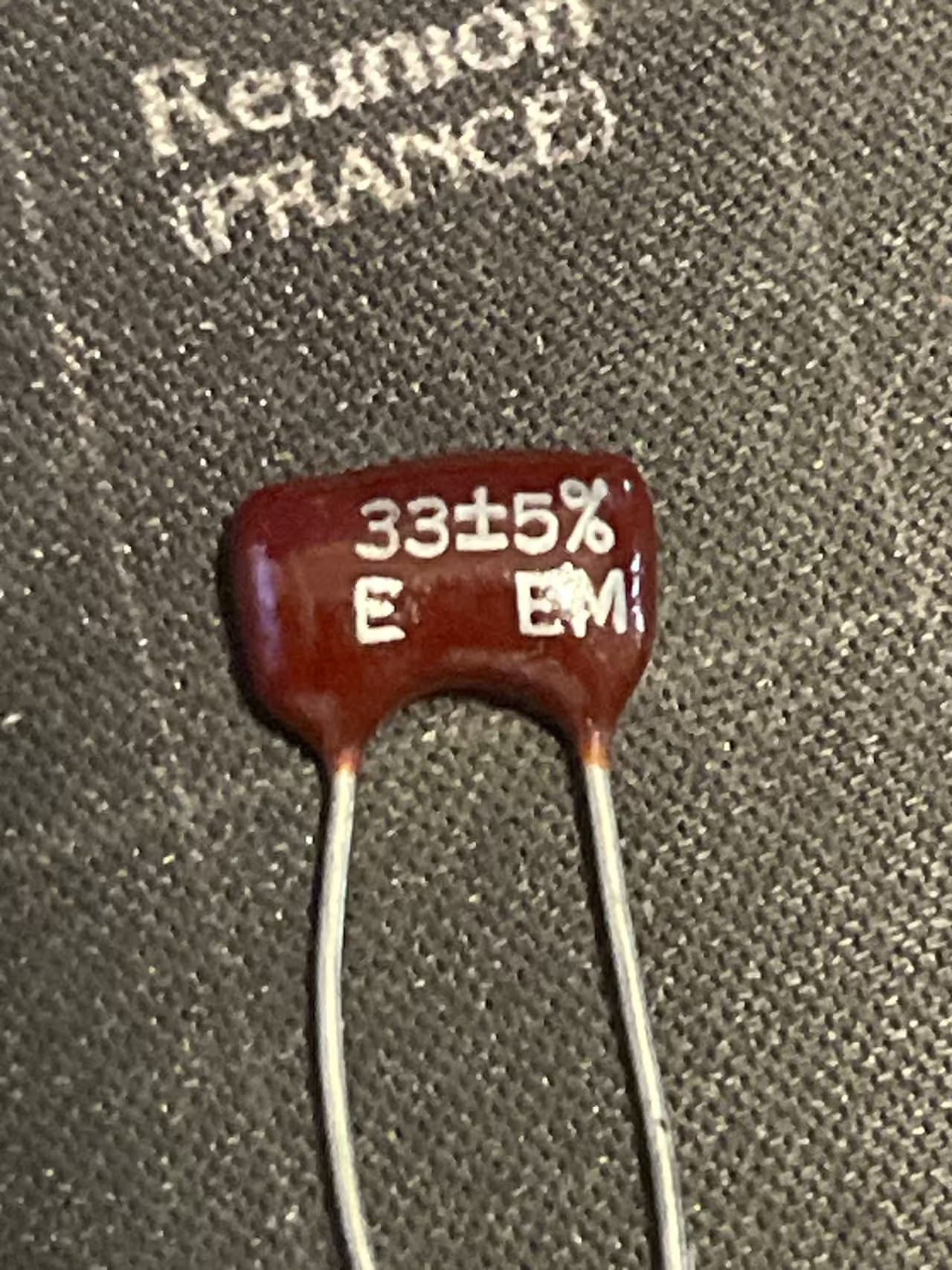
- 2 photos
Never used. The original pack has been opened, or the quantity was split off a full reel or tube. Leads are original and unclipped.
New old stock, open stock on the grading scaleSend the quantity you need. You get a quote back with shipping before anything is charged.
Video
Filmed on the bench. Sound is stripped from product clips.
- 0:13
Specifications
| Specification | Value |
|---|---|
| Identification | |
| Part number | VNZDMS94 |
| Manufacturer | El-Menco |
| Condition | New old stock, open stock |
| Date code | Not recorded |
| Package | Dipped mica, brown body, radial leads |
| Country of origin | Not recorded |
| Family | Not recorded |
| Stock number | VNZDMS94 |
| Overview | |
| Type | Dipped mica capacitor |
| Grade | Standard 5 percent. The same value in 2 percent is listed separately |
| Suggested use | Tuned circuits, oscillator trimming and coupling at radio frequency |
| Electrical | |
| Capacitance | 33 pF, printed on the body |
| Tolerance | Plus or minus 5 percent, printed on the body |
| Polarity | None. Mica capacitors are not polarised |
| Not established | |
| DC voltage rating | Not established. No voltage appears on the body |
| Characteristic | Not established. No characteristic letter is printed |
| Part number | Not established. The body carries a value, a tolerance and a maker mark |
| Markings as read | |
| Marking, value line | 33 plus or minus 5 percent |
| Marking, maker line | E EM |
| Provenance | |
| Manufacturer | El-Menco, from the EM mark |
| Quantity offered | One piece |
| Condition | New old stock, unused, coating intact and leads unsoldered |
| Physical | |
| Lead style | Radial, both leads from the same edge |
| Body | Dipped brown coating over a moulded mica body |
About this part
An El-Menco dipped mica capacitor marked 33 plus or minus 5 percent, with the EM maker mark beside it. New old stock, unused, leads straight.
Five percent is the standard grade for a precision mica and it is the tolerance most vintage circuits were designed around. That is worth stating plainly because this catalogue also lists the same value from the same maker at 2 percent, and the two are different products at different prices. If you are replacing a capacitor in a set whose service manual specifies 5 percent, this is the part, and paying for a tighter one buys nothing the circuit will use.
Where 5 percent earns its keep is anywhere the value has to stay put rather than merely be approximately right. At 33 pF you are almost certainly in a tuned circuit, and there the tolerance sets how far the resonance can sit from where the designer intended before an alignment runs out of adjustment. A 20 percent ceramic in the same position moves the frequency enough to matter and then moves again when the chassis warms up.
Mica is why it holds. The dielectric is a mineral crystal, dimensionally stable and effectively immune to the drift that afflicts class 2 ceramics, so a capacitor made in the 1950s measures today what it measured then. Nothing in it dries out, nothing needs reforming.
El-Menco was the trade name of the Electro Motive Manufacturing Company of Willimantic, Connecticut, and their dipped micas are a common and welcome sight inside American radio and test equipment of the period.
Questions about this part
Should I buy this or the 2 percent version?
Buy this one unless your circuit specifically calls for tighter. Five percent is the standard precision grade and it is what most vintage designs were built around, so a service manual asking for 5 percent is asking for exactly this. The 2 percent part costs more and buys nothing the circuit will use unless it is a laboratory instrument, a frequency standard or a filter where the response depends on the value holding closely.
Why does tolerance matter more at 33 pF than at 33 microfarads?
Because of what the capacitor is doing. A large capacitor is usually storing energy, where being 20 percent out changes nothing anyone notices. A 33 pF part is almost always setting a frequency in a tuned circuit, and there the value is one half of the equation that decides where the circuit resonates. Being loose moves the frequency, and if it moves far enough the alignment adjustment runs out before you reach the right place.
Will the value have drifted since it was made?
No, and that is the point of mica. The dielectric is a mineral crystal rather than a manufactured ceramic formulation, so it is dimensionally and thermally stable in a way class 2 ceramics are not. Nothing in the capacitor dries out or ages on a shelf. A part made in the 1950s should measure today within its original tolerance.
Is there a voltage rating?
Not on this body. Many dipped micas carried a value, a tolerance and a maker mark and nothing else, because the rating lived in the catalogue rather than on the part. Micas of this size were commonly rated at 300 or 500 volts and mica has a high breakdown strength, so this is not a fragile component, but we will not print a number we cannot read. If your circuit applies more than a hundred volts or so, establish the rating first.
How do I measure such a small value?
Zero your meter with the test leads attached before you start, because the leads alone contribute several picofarads and at 33 pF that is a ten percent error on its own. Keep the leads short and do not hold the body while measuring, since your hand adds capacitance too. A good one should read between about 31 and 35 pF.
Who were El-Menco?
The trade name of the Electro Motive Manufacturing Company of Willimantic, Connecticut, one of the small number of American firms that mattered in precision mica through the valve era. Their capacitors turn up throughout period radio, television, instrumentation and military equipment, and the EM mark on the body is theirs.
What condition is this one in?
New old stock, open stock, never fitted. The dipped coating is intact with no chips or cracks, the printing is fully legible, and both leads are straight and unsoldered with none of the kinks a previous installation leaves. The photographs show the actual capacitor.