
KH56JM2B058Japan Servo
$28.0012 in stockAsk for a quote
Manufacturer
Japan Servo was a Tokyo maker of small precision motors, and for decades it was one of the quiet suppliers whose products were everywhere and whose name almost nobody outside engineering knew. It built stepping motors, brushless DC motors, synchronous motors, gearmotors, blowers and cooling fans, and it sold most of them to equipment manufacturers rather than to end users. It became part of the Nidec group in the late 2000s and trades today as Nidec Servo, and motors carrying either name are listed together on this page.
What they were known for. Hybrid stepping motors, particularly the KH series, and the kind of consistency that gets a supplier designed into a product and kept there for fifteen years. Japan Servo steppers turned up in printers and plotters, banking and ticketing machines, laboratory and medical instruments, semiconductor handling equipment and vending machines. If a mechanism needed to go to a known position and hold it, without a feedback loop and without a fuss, this is the sort of motor that did it.
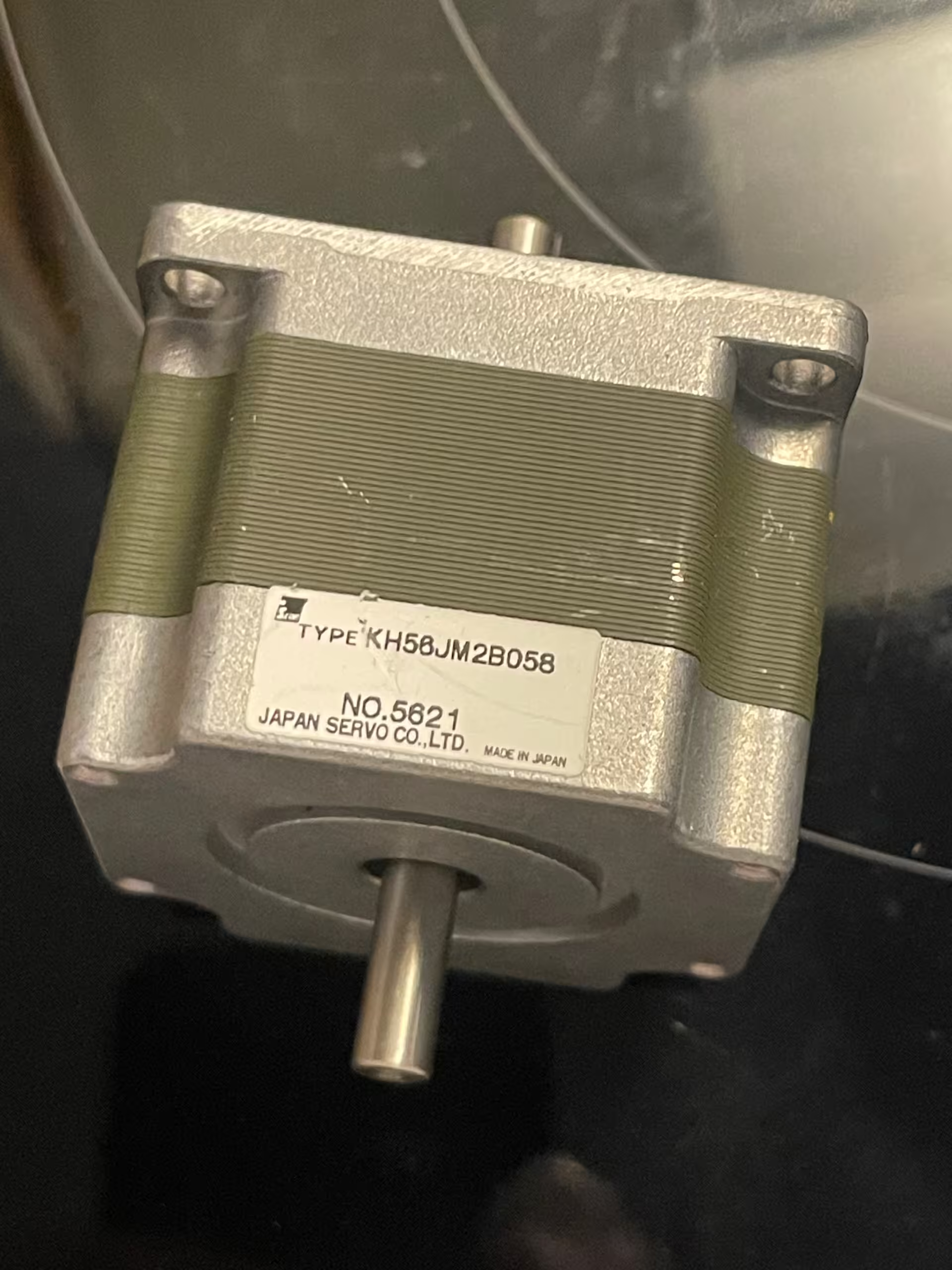
How to read what is on the label. Japanese motor makers describe the frame in millimetres rather than by the American NEMA number, so a KH56 is a 56 mm flange, which is the same physical frame the rest of the world calls NEMA 23. After the frame code the scheme becomes maker specific: winding, step angle, shaft and lead configuration are all in there, and there is no universal decoder. Motors built to a customer specification often carry a second number that belongs to the customer rather than to Japan Servo, and the KH56JM2B058 on this page is one of those, also marked No 5621. We list both numbers, because one of them is what somebody is searching for and there is no way to know which.
What this means for old stock. A stepper has no wear parts except its bearings and no consumables at all. Nothing in the windings or the magnets degrades on a shelf. What ages is the bearing grease, which stiffens and separates over years of standing still, and the cure is to turn the motor slowly under no load until it frees up. Check the two phase resistances against each other before you wire it to a driver, and check the flange for impact damage. Beyond that, an unused stepper is an unused stepper.
Physically, yes. Japanese makers give the flange dimension in millimetres and 56 mm is the same frame the NEMA 23 designation describes, with the same bolt circle. What still varies is body length, shaft diameter and length, and the electrical characteristics of the winding, so check those in the spec table before you assume a swap.
Usually a customer part number. Motors built into somebody equipment are frequently marked with the number that appears on that manufacturer bill of materials rather than only with the maker own designation. We list every number stamped or printed on the motor, because either one might be the one you are searching for.
Yes. A hybrid stepper has detent torque, meaning the rotor magnets pull against the stator teeth even with no power applied, so it steps and clicks by hand. Old bearing grease adds drag on top of that. Run it slowly and unloaded for a few minutes and it eases. A rumble or a scrape that does not improve is a different matter and worth telling us about.
Meter it. On a two phase motor you are looking for two coils with equal resistance and no continuity between them or to the case. That identifies the pairs, and from there the only unknown is which way round a pair goes, which changes the direction of rotation and nothing else. Send us a photo of the label and we will tell you what we can read from it.
It is the same operation under the Nidec group, renamed after the acquisition in the late 2000s. Older motors carry the Japan Servo name and newer ones carry Nidec Servo. We file parts by the marking on the motor, so a motor labelled Japan Servo is listed under that name.