
1U4Raytheon
$4.501 in stockAsk for a quote
Manufacturer
Raytheon began in Cambridge, Massachusetts in 1922, founded as the American Appliance Company by Vannevar Bush, Laurence Marshall and Charles Smith. Its first successful product was a gas filled rectifier tube that let a domestic radio run from the mains instead of from a bank of batteries, which at the time was the difference between a radio being furniture and a radio being a project. The tube was called the Raytheon, and by 1925 the company had taken its name from its own product, which is a rare direction of travel.
What they were known for. Tubes, first and for a long time. Receiving tubes, rectifiers, subminiature types for hearing aids and later for missiles, and the industrial and transmitting types in between. Then the war arrived and Raytheon worked out how to mass produce the cavity magnetron, the device that made airborne and shipborne radar practical, and it went from making thousands of tubes to making them on a scale nobody had attempted. That work led directly to the microwave oven, after a Raytheon engineer named Percy Spencer noticed what a live magnetron did to the sweet in his pocket, and it led equally directly to the missile and defence business the name means today.
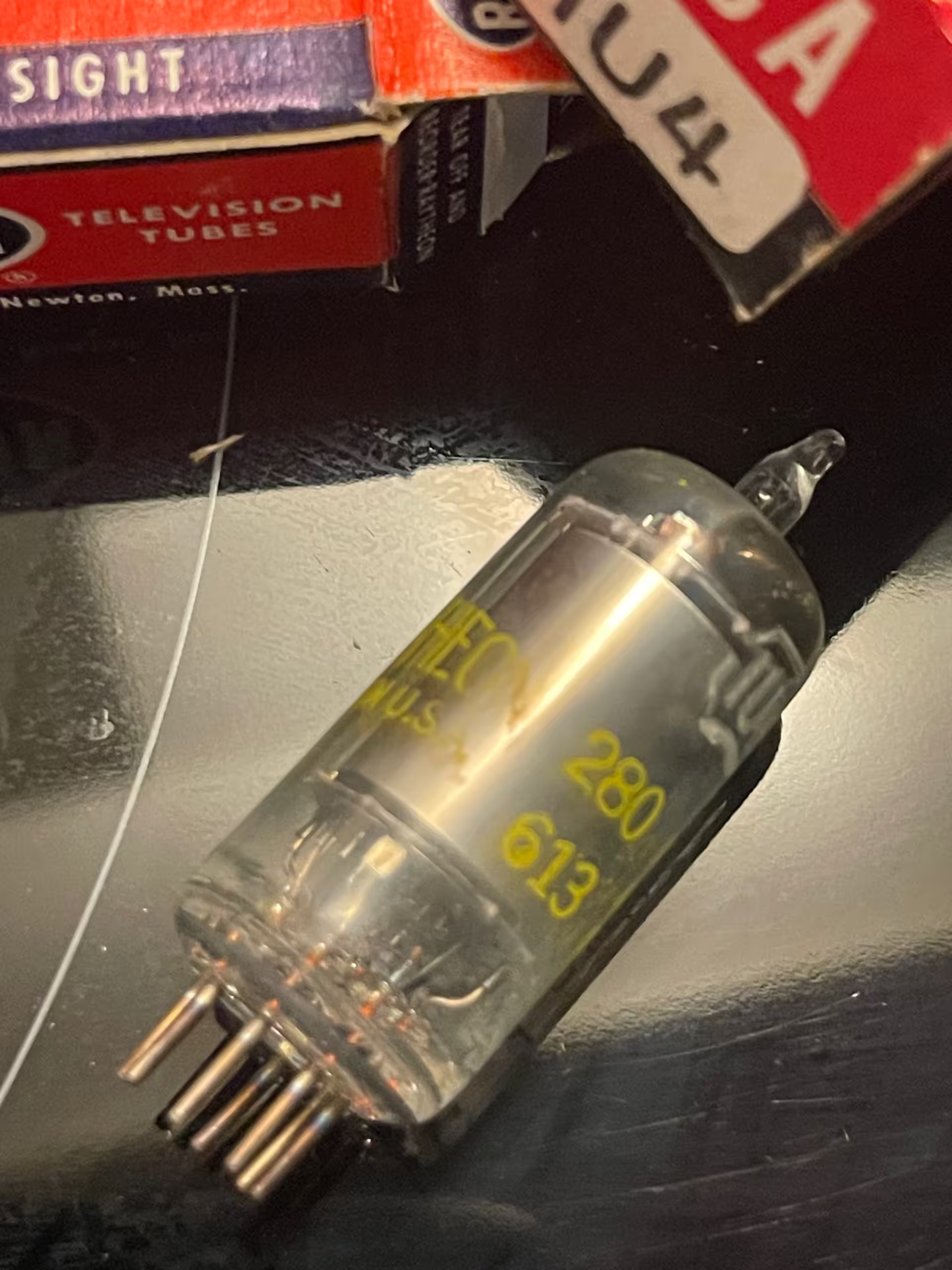
The tubes themselves. Raytheon receiving tubes are well regarded, and the ones that come through here are usually from the 1940s to the 1960s. The 1U4 on this page is characteristic: a seven pin miniature RF pentode on a B7G base, part of the 1.4 volt filament family built for battery portables, in an era when a portable radio ran from a dry battery pack the size of a brick. Types like it were made in enormous numbers and then made obsolete in a decade by the transistor.
What this means for buying. A tube number is a registered type, so a Raytheon 1U4 and any other maker 1U4 are the same electrical device. What the brand buys you is a premium in the collector market and, in the case of Raytheon, a manufacturing reputation that has held up. It buys nothing at all in specification. We list the marking, we describe the getter and the pins, and we let the market decide what the name is worth.
Not by specification. A tube number is a registered type and every maker of it had to meet the same published characteristics, so a 1U4 is a 1U4. What varies is manufacturing consistency and what the collector market will pay, and Raytheon does well on both. We describe the physical condition and the marking and leave the premium to the market.
The nominal filament voltage, which is 1.4 volts for that family. Those tubes were built for battery portable equipment where the filament ran directly from a dry cell. The last figure, 4, is the count of active elements including the filament. The middle letter is a sequence code and means nothing on its own.
Both happened, across the industry and across the decades. Receiving tube makers supplied each other and branded house labels for retailers, so a tube in a Raytheon carton was not always made in a Raytheon plant, and identifying the actual plant means reading the etched codes on the glass. We report the printed marking and the codes we can read, and we do not claim a plant of origin we cannot see.
They are sought after, especially the pencil types and the ruggedised military numbers, because they were made for guided weapons and hearing aids and were built to survive a great deal. When one comes through it is listed by its exact type number and graded like everything else, on the getter first and the pins second.