
Ceramic Disc Capacitor Marked 50 M, Sleeved Leads, Maker Not Identified
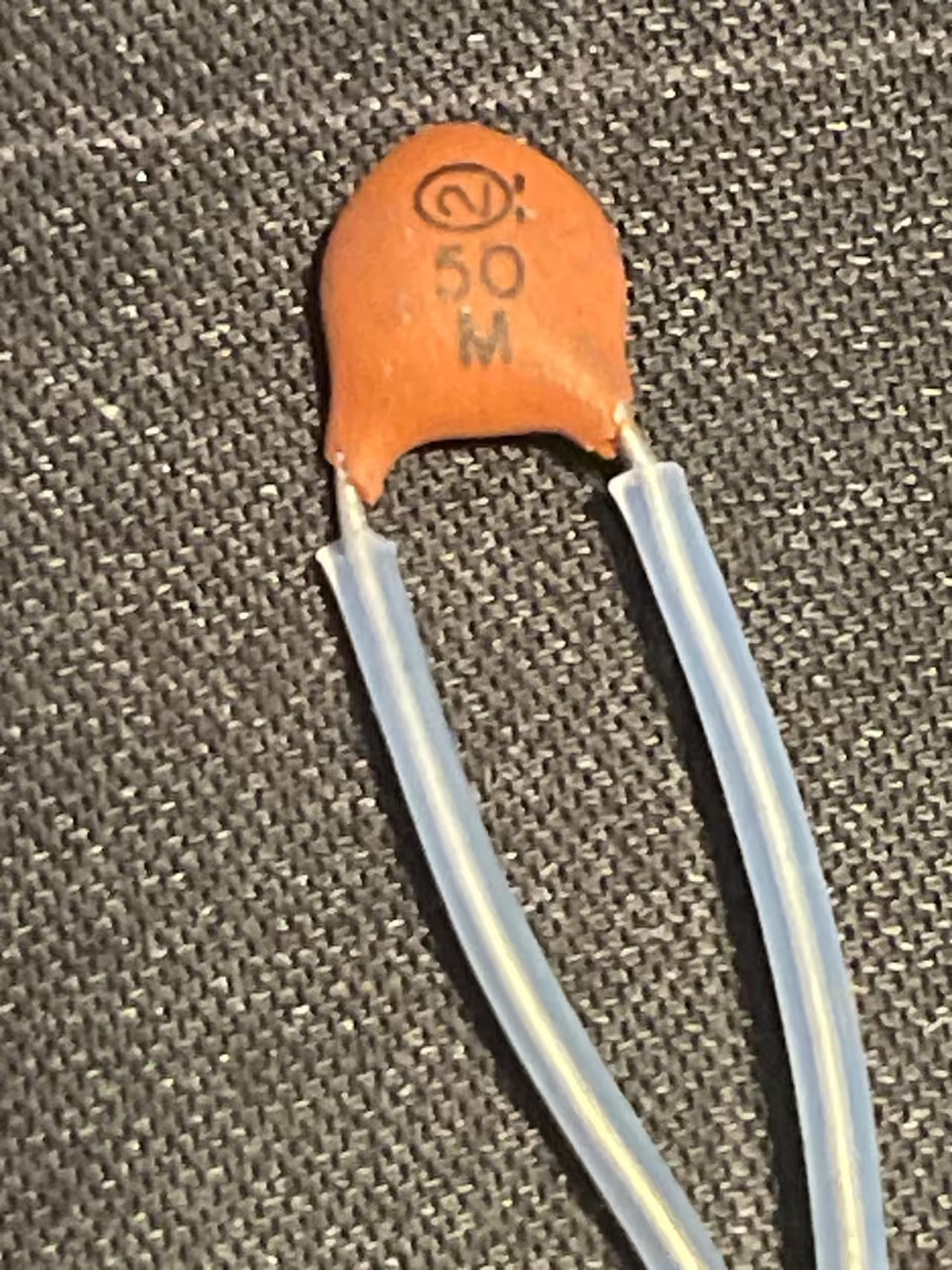
- 2 photos
Never used. The original pack has been opened, or the quantity was split off a full reel or tube. Leads are original and unclipped.
New old stock, open stock on the grading scaleSend the quantity you need. You get a quote back with shipping before anything is charged.
Video
Filmed on the bench. Sound is stripped from product clips.
- 0:05
Specifications
| Specification | Value |
|---|---|
| Identification | |
| Part number | VVZAXWXS |
| Manufacturer | Not recorded |
| Condition | New old stock, open stock |
| Date code | Not recorded |
| Package | Radial ceramic disc, dipped orange coating, leads in clear insulating sleeves |
| Country of origin | Not recorded |
| Family | Not recorded |
| Stock number | VVZAXWXS |
| Electrical | |
| Capacitance | 50 pF, from the 50 printed on the body |
| Tolerance | Plus or minus 20 percent, from the M code |
| Polarity | None. Ceramic capacitors are not polarised |
| Not established | |
| DC voltage rating | Not established. No voltage is printed on the body |
| Dielectric | Ceramic disc. Class not established, no temperature characteristic code is printed |
| Manufacturer | Not identified. The circled logo has not been matched |
| Markings as read | |
| Marking, logo | A maker's symbol inside a printed circle, not matched to a company |
| Marking, value line | 50 |
| Marking, tolerance line | M |
| Physical | |
| Lead style | Radial, both leads from the same edge of the disc |
| Lead insulation | Clear sleeving fitted to both leads, original and uncut |
| Body | Dipped orange coating over a ceramic disc |
| Provenance | |
| Quantity offered | One piece |
| Condition | New old stock, unused, coating intact, sleeving present and leads unsoldered |
| Basis of identification | The printed markings only. No brand is claimed |
| Overview | |
| Suggested use | Radio frequency tuning, trimming and coupling |
About this part
An orange ceramic disc capacitor marked with a circled maker's logo above the value 50 and the letter M. Both leads carry clear insulating sleeves. New old stock, unused.
The sleeves are the detail worth noticing, because they tell you something about where this part was meant to go. A bare disc capacitor is fine on a tag strip with room around it, but slide two sleeved leads into a crowded chassis and they can lie against a valve holder, a can or another component without shorting to it. Factories fitted sleeving where lead dress was tight or where the voltages nearby made a stray touch expensive. Finding them still on an unused part means nobody has cut it about.
The marking reads as 50 pF with M for plus or minus 20 percent, which is the ordinary reading of a value and a tolerance letter on a disc of this era. Fifty picofarads is a radio frequency value: trimming an oscillator, coupling an aerial stage, setting a resonance. It is not a decoupling part.
No voltage is printed, and no maker's name either. The circled logo is a maker's mark we have not matched to a company. What we can say is what is on the body and what the body is, and the FAQs below cover what a buyer can establish in a few minutes with a meter.
Questions about this part
Why do the leads have sleeves on them?
Because somebody expected this part to be fitted somewhere tight. Sleeving stops a lead shorting against a chassis, a valve holder, a screening can or a neighbouring component when there is no room to dress it clear. Factories fitted it where lead dress was awkward or where the voltage nearby made an accidental touch expensive. It is a small thing that tells you the part came from a properly engineered assembly rather than a parts bin.
Should I keep the sleeving?
If it will fit where you are putting it, yes. It is original, it is intact, and it is doing the job it was fitted for. It also identifies the capacitor as unused, since sleeving is usually the first casualty of a part being pulled from a board. If it is in the way, it slides off without damage.
What does 50 M decode to?
Fifty picofarads with a tolerance of plus or minus 20 percent. On a disc of this era a bare number is read as picofarads directly, with no multiplier, and a trailing letter is the tolerance code where M is 20 percent. That reading is consistent with the physical size of the disc, which is far too small to be 50 of anything larger.
What is 50 pF used for?
Radio frequency work. At this value the capacitor is setting or trimming a resonance rather than storing energy, so it turns up across a tuned circuit, coupling an aerial stage, or providing feedback in an oscillator. Nobody uses 50 pF for supply decoupling, because there is nothing to decouple with.
Does the missing voltage rating matter?
It depends where you are putting it. Ceramic discs of this size were commonly rated at 500 volts or more, since ceramic has a high breakdown strength and the dielectric is thick relative to the tiny capacitance. But no number is printed, so none is claimed here. For a low voltage radio frequency stage it is a non issue. For anything with a few hundred volts across it, establish the rating first.
How stable will the value be?
That depends on a ceramic class the part does not state. A class 1 formulation holds its value well and would be the right choice at this value in a tuned circuit; a class 2 drifts with temperature and falls under DC bias. With no temperature characteristic code printed, measure it warm and cold if the resonance matters. A 20 percent tolerance suggests a general purpose part rather than a precision one.
What condition is this one in?
New old stock, open stock, never fitted. The dipped coating is intact with no chips or cracks, the printed markings are legible, the original clear sleeving is present and uncut on both leads, and the leads themselves are unsoldered. The photographs show the actual capacitor.