
Ceramic Disc Capacitor, Markings Not Legible, Value To Be Measured
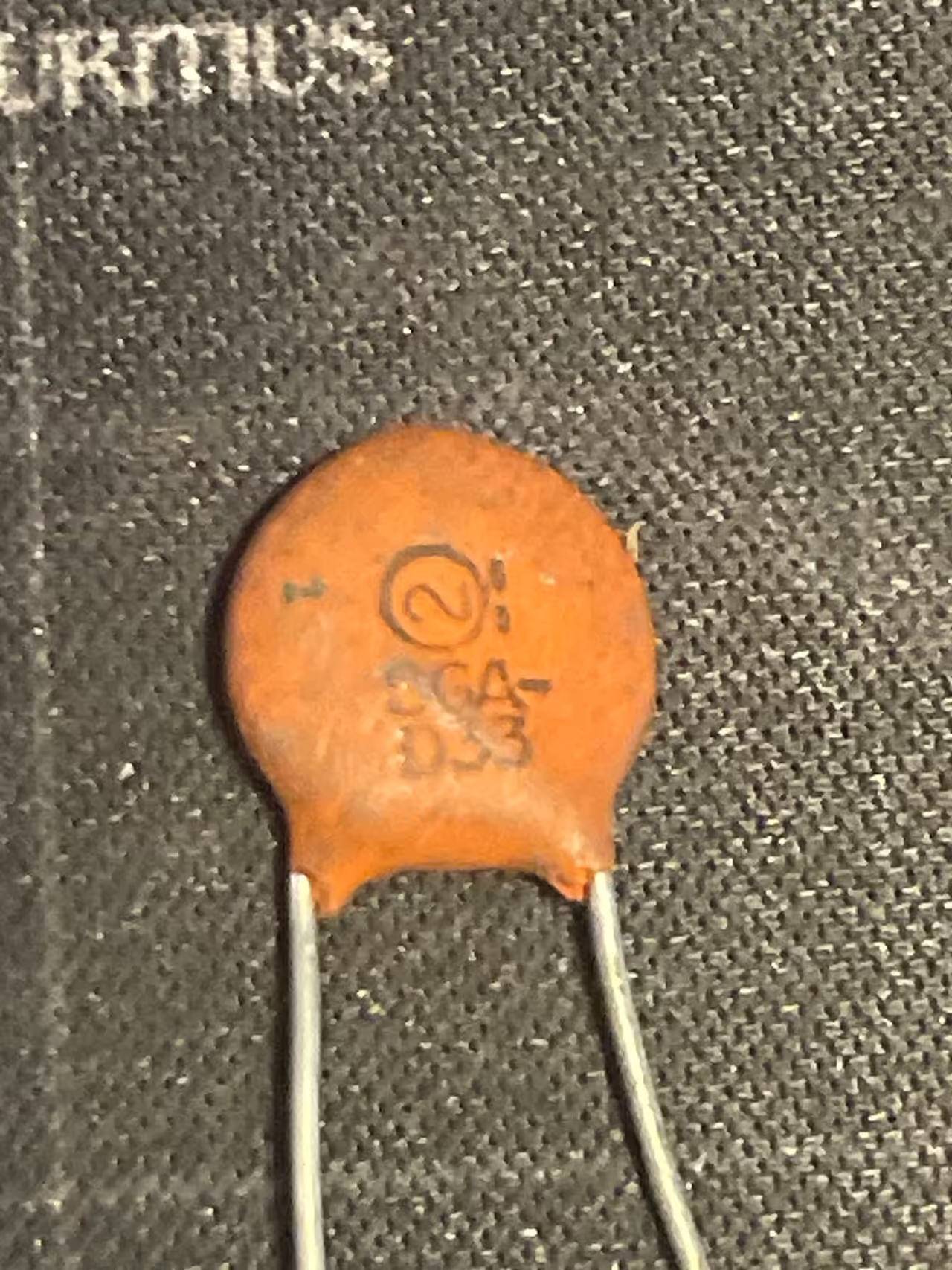
- 2 photos
Never used. The original pack has been opened, or the quantity was split off a full reel or tube. Leads are original and unclipped.
New old stock, open stock on the grading scaleSend the quantity you need. You get a quote back with shipping before anything is charged.
Video
Filmed on the bench. Sound is stripped from product clips.
- 0:13
Specifications
| Specification | Value |
|---|---|
| Identification | |
| Part number | VW8GC9KN |
| Manufacturer | Not recorded |
| Condition | New old stock, open stock |
| Date code | Not recorded |
| Package | Radial ceramic disc, dipped orange coating, two tinned leads |
| Country of origin | Not recorded |
| Family | Not recorded |
| Stock number | VW8GC9KN |
| Not established | |
| Capacitance | Not established. The printed value has faded past reading |
| Tolerance | Not established |
| DC voltage rating | Not established |
| Dielectric | Ceramic disc. Class not established |
| Manufacturer | Not identified. A circled maker's symbol is visible but has not been matched |
| Markings as read | |
| Marking, logo | A maker's symbol inside a printed circle, legible as a shape |
| Marking, lower lines | Two lines of characters, worn past the point of a confident reading |
| Physical | |
| Lead style | Radial, both leads from the same edge of the disc |
| Body | Dipped orange coating over a ceramic disc, intact and unchipped |
| Electrical | |
| Polarity | None. Ceramic capacitors are not polarised |
| Provenance | |
| Physical condition | Sound. The fault is in the printing, not the component |
| Quantity offered | One piece |
| Condition | New old stock, unused, leads bright and unsoldered |
| Basis of identification | Nothing beyond the visible construction. No value is claimed |
| Overview | |
| What the buyer needs | A capacitance meter. One measurement settles what the printing will not |
| Priced as | An unknown value, well below a marked equivalent |
About this part
An orange ceramic disc capacitor whose printed markings have faded past the point of reading. New old stock, unused, but sold as an unknown value and priced accordingly.
What is legible is a maker's symbol inside a printed circle, and beneath it two lines of characters that have worn to the point where no honest reading is possible. We photographed it, magnified it and contrast stretched it, and the result is a partial shape rather than a value. Printing a guess would be worse than useless: a buyer who fits a capacitor believing it is one value when it is another has a fault that is very hard to find.
So this is listed for what it actually is, which is a physically sound unused ceramic disc of unknown value. That is a genuinely useful thing to a buyer with a capacitance meter and a parts drawer, and completely useless to anyone who needs a specific number today. The price reflects which of those two people it is for.
The good news is that measuring it takes seconds and requires nothing exotic. Unlike an electrolytic, a ceramic needs no forming, no reservations about age, and no waiting. Whatever it reads on a meter is what it is and what it will stay, because ceramic does not drift in storage.
The body is intact, the coating unchipped and both leads are straight, bright and unsoldered.
Questions about this part
Why not just estimate the value from the size?
Because size narrows it to a range, not a number, and a range is not what anybody fits. A disc of this diameter could be anywhere from a few tens of picofarads to a few nanofarads depending on its dielectric class, and the class is not printed either. An estimate would look like information while being worth nothing, and a buyer who trusts it and fits the capacitor has bought himself a fault that is genuinely hard to find.
How do I find out what it is?
Measure it. Any meter with a capacitance range reads a ceramic disc in seconds, and unlike an electrolytic there is no forming, no soak time and no age related caveat. Zero the meter with the leads attached first, because at small values the leads themselves contribute a few picofarads. Whatever it reads is what it is.
Can I trust a capacitor I cannot read?
Electrically, more than you might think. Ceramic has no liquid to dry, no seal to perish and no oxide layer to reform, so the failure modes that make an unmarked old electrolytic a gamble simply do not apply. The component here is sound; only the ink has failed. What you cannot trust is any assumption about its value or its voltage rating, which is why neither is stated.
What is the risk if I fit it without knowing the voltage rating?
That is the one to take seriously. A ceramic disc will usually be rated at several hundred volts, but usually is not a specification. In a low voltage circuit the question is academic. Anywhere with a few hundred volts across the capacitor, use a part whose rating you can read, because a ceramic that breaks down tends to fail as a short and takes whatever is upstream with it.
Why is it listed at all rather than thrown away?
Because an unused capacitor of unknown value is worth something to the right buyer and nothing to the wrong one, and the listing exists to tell those two apart. If you keep a parts drawer and a meter, a sound disc for a low price is a reasonable thing to own. If you need 47 pF today, buy a marked one.
Would you identify it if you could?
Yes, and we tried. The photographs were magnified and contrast stretched, which resolved markings on several other parts in this catalogue, but on this one it produced a partial shape rather than characters. The circled maker's logo survives well enough to see, and if you recognise it we would be glad to hear, since that would at least tell us whose numbering scheme to read the rest against.
What condition is it in?
New old stock, open stock, never fitted. The dipped coating is intact with no chips or cracks, the disc is undamaged, and both leads are bright, straight and unsoldered. The only defect is the faded printing, which is a marking problem rather than a component one.