
El-Menco
El-Menco 33 pF 2 Percent Precision Dipped Mica Capacitor, Radial
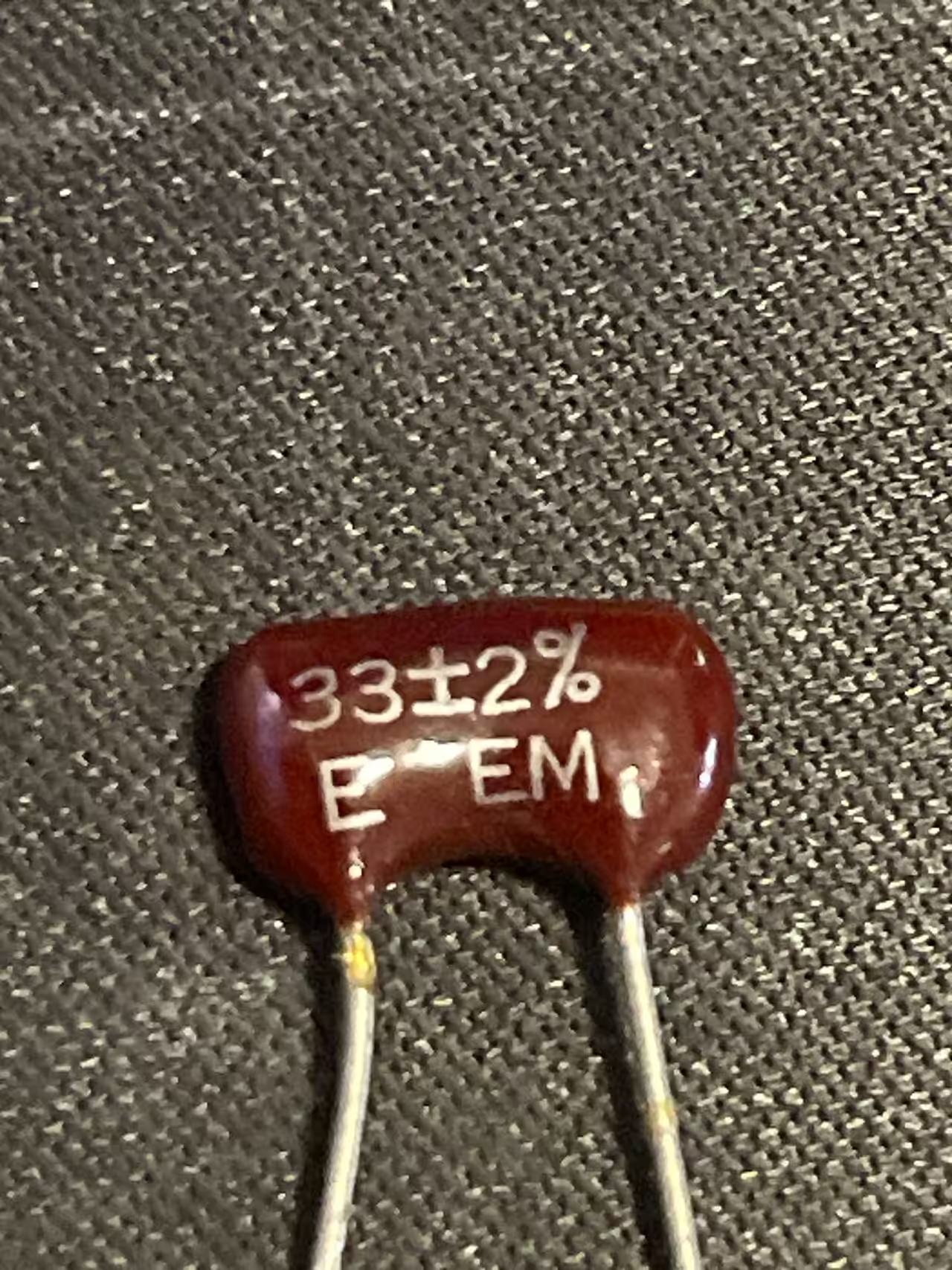
- 3 photos
Never used. The original pack has been opened, or the quantity was split off a full reel or tube. Leads are original and unclipped.
New old stock, open stock on the grading scaleSend the quantity you need. You get a quote back with shipping before anything is charged.
Video
Filmed on the bench. Sound is stripped from product clips.
- 0:07
Specifications
| Specification | Value |
|---|---|
| Identification | |
| Part number | VP7HWF92 |
| Manufacturer | El-Menco |
| Condition | New old stock, open stock |
| Date code | Not recorded |
| Package | Dipped mica, brown body, radial leads |
| Country of origin | Not recorded |
| Family | Not recorded |
| Stock number | VP7HWF92 |
| Overview | |
| Type | Dipped mica capacitor, precision grade |
| Grade | Precision 2 percent. The same value in 5 percent is listed separately and costs less |
| Suggested use | Filters, oscillators, frequency standards and matched pairs |
| Electrical | |
| Capacitance | 33 pF, printed on the body |
| Tolerance | Plus or minus 2 percent, printed on the body |
| Polarity | None. Mica capacitors are not polarised |
| Not established | |
| DC voltage rating | Not established. No voltage appears on the body |
| Characteristic | Not established. No characteristic letter is printed |
| Part number | Not established. The body carries a value, a tolerance and a maker mark |
| Markings as read | |
| Marking, value line | 33 plus or minus 2 percent |
| Marking, maker line | E EM |
| Provenance | |
| Manufacturer | El-Menco, from the EM mark |
| Quantity offered | One piece |
| Condition | New old stock, unused, coating intact and leads unsoldered |
| Physical | |
| Lead style | Radial, both leads from the same edge |
| Body | Dipped brown coating over a moulded mica body |
About this part
An El-Menco dipped mica capacitor marked 33 plus or minus 2 percent, with the EM maker mark. New old stock, unused.
Two percent is a precision grade and it was never the cheap option. Mica capacitors were not trimmed to value: they were made and then measured and sorted, so a 2 percent part is one that came out of the same production run as the 5 percent parts and happened to land inside a tighter window. That is why a tolerance grade costs money and why the tight ones are scarcer in surplus. You are buying the tail of a distribution.
What that buys is worth having in three specific places. In a filter, where the response shape depends on the ratio between components rather than their absolute values, loose parts blunt the corner. In an oscillator or a frequency standard, where the capacitor is half of what sets the frequency and there may be little or no adjustment. And in a matched pair, where two capacitors need to be close to each other and the cheapest way to guarantee that is to buy two from a tight grade.
If your circuit does not do any of those things, the 5 percent version of exactly this part is listed separately and is the sensible purchase.
Mica holds its value because the dielectric is a mineral crystal rather than a ceramic formulation, so a precision grade made decades ago is still a precision part today. Nothing in it ages on a shelf.
Questions about this part
Why is a 2 percent part more expensive than a 5 percent one?
Because it is scarcer, and for an interesting reason. Mica capacitors were not adjusted to value during manufacture. They were built, measured and sorted, so the tight grades are simply the units that happened to land closest to nominal out of the same production run. A maker cannot decide to produce more 2 percent parts without producing more of everything, so the tight grade has always been the scarce end of the distribution.
When do I actually need 2 percent?
Three cases mainly. A filter, where the shape of the response depends on the ratio between components and loose parts round off the corner. An oscillator or frequency standard, where the capacitor sets the frequency and there may be little adjustment to pull it back. And a matched pair, where two capacitors have to be close to each other, and buying from a tight grade is the cheap way to guarantee it. Outside those, the 5 percent version does the same job.
Is the 5 percent version the same capacitor otherwise?
Same maker, same value, same construction, same body. The only difference is which side of a measurement it fell on. Both are listed here, so if your circuit does not need the tight grade you can buy the standard one and spend the difference elsewhere. We separate them because selling a 5 percent part as a precision one, or charging precision money for a standard one, would be misleading in either direction.
Does a tolerance grade drift over decades?
Not meaningfully, which is what makes buying old precision mica reasonable. The dielectric is a mineral crystal rather than a manufactured ceramic that relaxes over time, so the value it was sorted into is the value it still holds. There is no electrolyte to dry and nothing to reform. Measure it if the application is critical, but expect it to be inside its window.
Is there a voltage rating?
Not printed on this body. Dipped micas of this size commonly carried value, tolerance and a maker mark only, with the rating living in the catalogue. Parts like this were usually rated at 300 or 500 volts, and mica has a high breakdown strength, but we will not state a number we cannot read. Establish it before applying more than a hundred volts or so.
How do I verify the tolerance on arrival?
Carefully, because the measurement is harder than the part. Zero your meter with the leads attached, keep them short, and do not hold the body, since a hand adds capacitance. At 33 pF a 2 percent window is roughly 32.3 to 33.7 pF, which is tighter than many hobby meters can resolve. If you cannot measure to better than a picofarad, you cannot verify a 2 percent part, only a 5 percent one.
What condition is this one in?
New old stock, open stock, never fitted. The dipped coating is intact with no chips or cracks, the printed value and tolerance are fully legible, and both leads are straight and unsoldered. The photographs show the actual capacitor you would receive.