
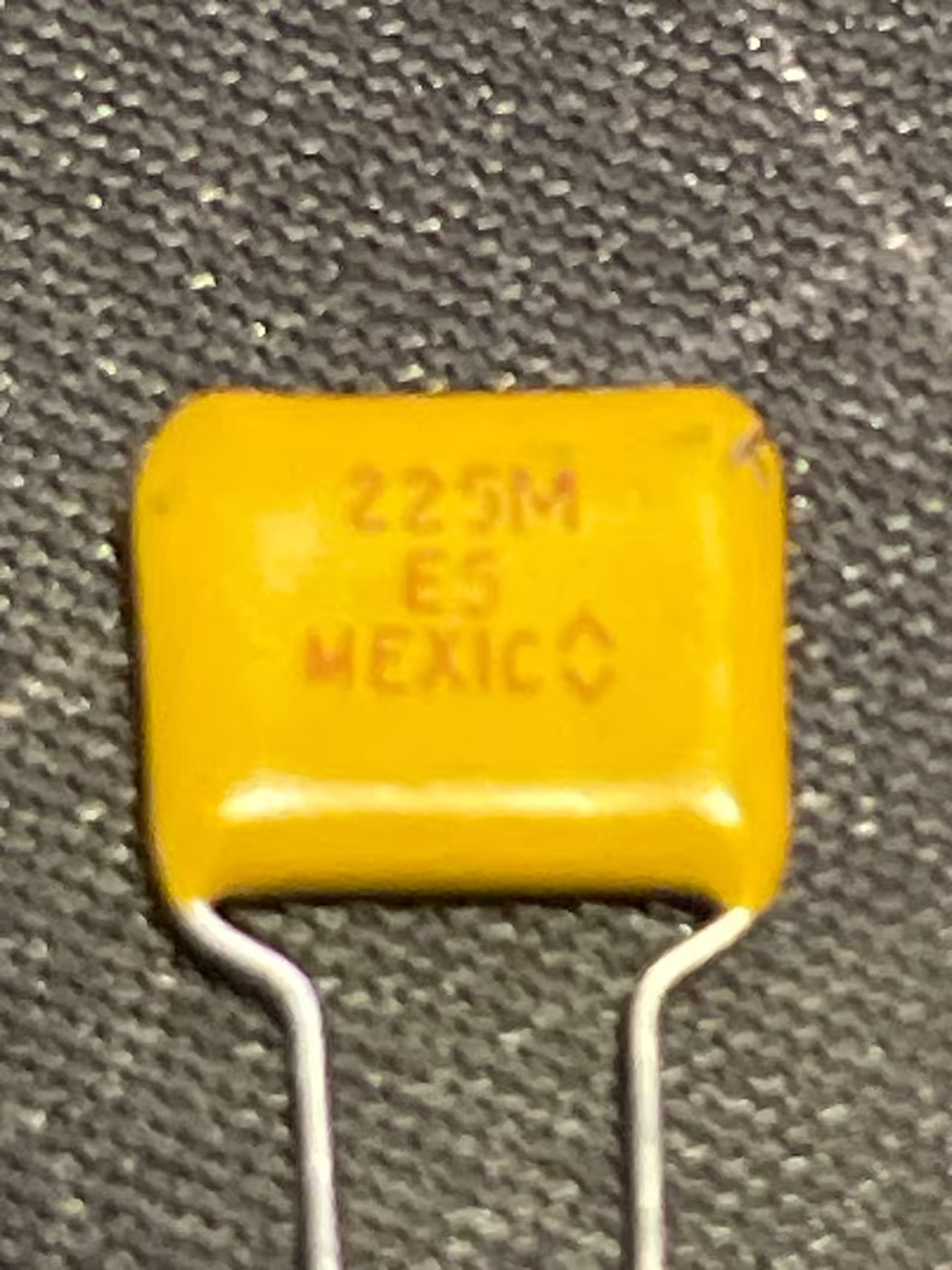
Dipped Radial Capacitor Marked 225M E5 MEXICO, 2.2 uF 20 Percent, Maker Not Identified
- 2 photos
Never used. The original pack has been opened, or the quantity was split off a full reel or tube. Leads are original and unclipped.
New old stock, open stock on the grading scaleSend the quantity you need. You get a quote back with shipping before anything is charged.
Video
Filmed on the bench. Sound is stripped from product clips.
- 0:27
Specifications
| Specification | Value |
|---|---|
| Identification | |
| Part number | S8FP4PNE |
| Manufacturer | Not recorded |
| Condition | New old stock, open stock |
| Date code | Not recorded |
| Package | Dipped radial, squared yellow body, two tinned leads |
| Country of origin | Mexico |
| Family | Not recorded |
| Stock number | S8FP4PNE |
| Electrical | |
| Capacitance | 2.2 uF, from the 225 code |
| Tolerance | Plus or minus 20 percent, from the M code |
| Polarity | None. No polarity mark and no stripe |
| Not established | |
| Voltage rating | Not established. No voltage is printed on the body |
| Dielectric | Not established. Consistent with metallized polyester film or with monolithic ceramic |
| Manufacturer | Not identified. The diamond mark has not been matched to a company |
| Markings as read | |
| Marking, line 1 | 225M |
| Marking, line 2 | E5 |
| Marking, line 3 | MEXICO, with a small diamond shaped maker's mark alongside |
| Physical | |
| Lead style | Radial, two tinned wire leads from one face |
| Body | Squared dipped coating, yellow, rounded corners |
| Provenance | |
| Country of origin | Mexico, printed on the body |
| Condition | New old stock, unused, leads unsoldered and unbent |
| Basis of identification | The 225M code alone. Everything else here is read from the body or recorded as unknown |
| Quantity offered | One piece |
| Overview | |
| Suggested use | Low voltage coupling, decoupling and timing, once a working voltage is confirmed |
About this part
A yellow dipped radial capacitor carrying three lines of marking and nothing else: 225M, E5, and MEXICO, with a small diamond shaped maker's mark beside the country. New old stock, leads straight and untouched by any iron.
What the marking establishes is the value. 225 is the standard three digit code, two significant figures then a multiplier, so 22 followed by five zeros in picofarads, which is 2.2 uF. The M is the tolerance letter and means plus or minus 20 percent. That much is certain and it is the number a buyer is shopping for.
What the marking does not establish is who made it, what the dielectric is, or what voltage it will stand. There is no voltage anywhere on the body, and that is the important gap. A capacitor with no printed voltage rating cannot be assumed safe at mains potential or anywhere near it, so treat this as a low voltage part until you have measured or sourced a rating. The diamond mark is a maker's logo we have not matched to a company.
On the dielectric, the body shape is genuinely ambiguous and we are not going to pretend otherwise. A squared yellow dipped radial at 2.2 uF is consistent with a metallized polyester film capacitor, and it is equally consistent with a monolithic ceramic of the sort several makers produced in Mexico in the 1980s. The two behave differently under bias and temperature, so the distinction matters, and an FAQ below gives the bench test that settles it in a couple of minutes.
The E5 line is unexplained. It sits where a date or plant code usually sits and it is not an electrical parameter in any scheme we could match.
Questions about this part
Why is there no voltage rating on this listing?
Because there is none on the capacitor. Three lines are printed on the body and none of them is a voltage. We will not put a number in that field that we cannot read off the part or trace to a datasheet, because the voltage rating is the one specification that decides whether a capacitor survives or fails short. Treat it as a low voltage part and measure or source a rating before putting it anywhere near mains.
How do I tell whether it is film or ceramic?
Two quick tests. Measure the capacitance cold, then warm the body gently between your fingers and measure again: a class 2 ceramic will move several percent, a polyester film barely moves. Then measure again with a few volts of DC bias applied: a class 2 ceramic loses capacitance under bias, sometimes a lot of it, while film does not care. If both tests show almost no change, you have film.
What does 225M decode to?
It is the standard three digit picofarad code. The first two digits are significant figures, 22, and the third is the number of zeros to add, five. That gives 2200000 pF, which is 2.2 uF. The trailing letter is tolerance, and M is plus or minus 20 percent. The same convention is why a part marked 104 is 0.1 uF.
Is a 20 percent tolerance a problem?
It depends entirely on the job. For supply decoupling or general coupling, 20 percent is irrelevant and nobody would specify tighter. For anything that sets a frequency, a time constant or a filter corner it is far too loose, and you want a film capacitor at 5 or 10 percent or better. Measure the actual value if it matters, since a 20 percent part often lands well inside its window.
What is the E5 line?
Unexplained. It sits where a date code or a plant code usually sits and it is not an electrical parameter in any scheme we could match. We have recorded it as read rather than guessing at a decode, because a wrong expansion of a code is worse than an honest gap. If you recognise the format we would like to hear about it.
Does a capacitor like this go bad sitting in a drawer?
Not in any way that matters, whichever dielectric it turns out to be. Neither polyester film nor ceramic dries out, and neither needs reforming the way an electrolytic does. The failure modes for both are mechanical damage and voltage stress in service, and this one has seen neither. What ages on a shelf is the solderability of the leads, and these are bright.
What condition is this one in?
New old stock, open stock. Never fitted, never soldered. The dipped coating is intact with no chips or cracks, the printing is fully legible and the leads are straight and clean. The photographs are of the actual capacitor you would receive.