
Axial Capacitor Marked 103, 10 nF, Black Body, Maker Not Identified
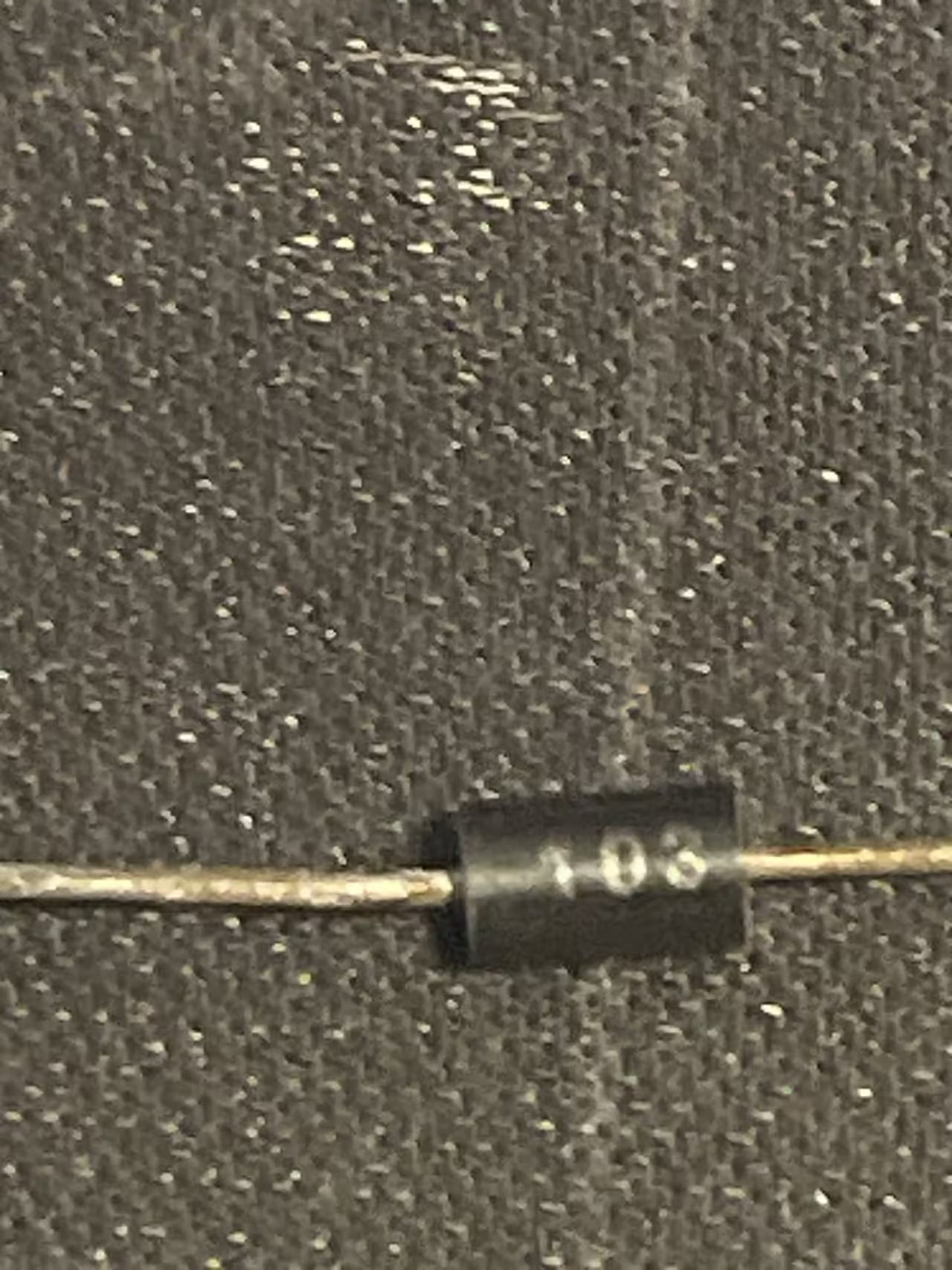
- 2 photos
Never used. The original pack has been opened, or the quantity was split off a full reel or tube. Leads are original and unclipped.
New old stock, open stock on the grading scaleSend the quantity you need. You get a quote back with shipping before anything is charged.
Video
Filmed on the bench. Sound is stripped from product clips.
- 0:13
Specifications
| Specification | Value |
|---|---|
| Identification | |
| Part number | RHW4HD6R |
| Manufacturer | Not recorded |
| Condition | New old stock, open stock |
| Date code | Not recorded |
| Package | Axial leaded black moulded or dipped body |
| Country of origin | Not recorded |
| Family | Not recorded |
| Stock number | RHW4HD6R |
| Markings as read | |
| Marking on the body | 103 |
| Manufacturer name on the part | None visible on the part or in any photograph |
| Type or series number on the part | None visible |
| Tolerance letter | None visible |
| Temperature characteristic code | None visible |
| Voltage marking on the body | None visible |
| Date or lot code on the body | None visible |
| Electrical | |
| How the 103 code decodes | 1 and 0 are the significant figures, 3 is the number of zeros that follow, and the result is in picofarads |
| Capacitance from the 103 code | 0.01microfarad |
| Capacitance, alternative units | 10 nF, 10000 pF |
| Recorded, not marked | |
| Voltage recorded at capture | 50 V. This came from the operator's record when the part was unpacked, not from a marking on the part. |
| Not established | |
| Tolerance | Not marked and not established |
| Dielectric | Not marked and not established |
| Physical | |
| Lead configuration | Axial, one lead from each end of the body |
| Body finish | Black, moulded or dipped |
| Before you fit it | |
| Recommended checks on arrival | Capacitance to confirm the 103 decode, then leakage or dissipation factor |
About this part
The only marking on this part is a three digit code: 103. In the EIA scheme used on small capacitors the first two digits are significant figures and the third is the count of zeros that follow, with the result in picofarads. So 103 reads as 10 followed by three zeros, 10000 pF, which is 10 nF, which is 0.01 uF. Those are three ways of writing one number, and the choice is regional habit.
What the code does not tell you runs longer than what it does. No tolerance letter follows, so the part could be a close tolerance one or a class 2 ceramic at plus 80 and minus 20 percent. No temperature characteristic code appears, so the dielectric is open. No voltage appears on the body at all: the 50 volt figure in this listing came from the operator's record when the part was unpacked, not from a marking, and the spec table gives it its own row saying so. No maker name appears anywhere.
The trap with a bare three digit code is reading it as an ordinary number. A part marked 103 is not 103 pF, and the part marked 101 is the 100 pF one. Loose in a drawer those two sit one character apart and behave nothing alike, which is how a wrong value ends up soldered in. Put a meter on it when it arrives. A capacitance reading confirms the decode, and a leakage or dissipation check says whether storage has told on it. Until the rating is confirmed, treat 50 volts as a ceiling rather than a target.
Questions about this part
What does the marking 103 mean?
It is the three digit EIA capacitance code. The first two digits are significant figures, the third is how many zeros follow, and the answer is in picofarads. So 103 is 10000 pF, written elsewhere as 10 nF or 0.01 uF.
Could 103 mean 103 pF?
No. A part of 103 pF would not be marked that way under this scheme. The code that gives 100 pF is 101. This is one of the more common misreadings in a parts drawer, and it puts a value out by a factor of a hundred.
What is the voltage rating?
Nothing on the body states one. The 50 volt figure in this listing is what the operator recorded when the part was unpacked and photographed, so it is an inventory record rather than a reading off the part. Treat it as the ceiling until you have confirmed it, and do not carry it into a high voltage position.
Who made it?
Not known. There is no maker name, logo or part number on the body, so the listing carries no manufacturer rather than a plausible one. A small black axial body with only a value code on it was common to several makers and does not point at any one of them.
What tolerance is it?
Not established. A tolerance letter such as J for 5 percent, K for 10 percent or M for 20 percent would normally follow the digits, and none is present here. Measure the part if the value has to hold.
Where is 0.01 uF used at low voltage?
Supply pin decoupling on logic and small signal analogue boards, radio frequency bypass to ground, small snubbers across signal lines and relay contacts, and the timing and filter positions of low voltage circuits, where the dielectric matters as much as the value does.
What should I check when it arrives?
Measure the capacitance first, which confirms the 103 decode and tells you the part behaves as a capacitor at all. Then check leakage, or dissipation factor if your meter reads it. Finally look at the leads for corrosion and at the body for chips or cracks in the coating.