
Cornell Dubilier
Cornell Dubilier CDE 270 pF 5 Percent Moulded Mica Capacitor, Voltage Not Marked
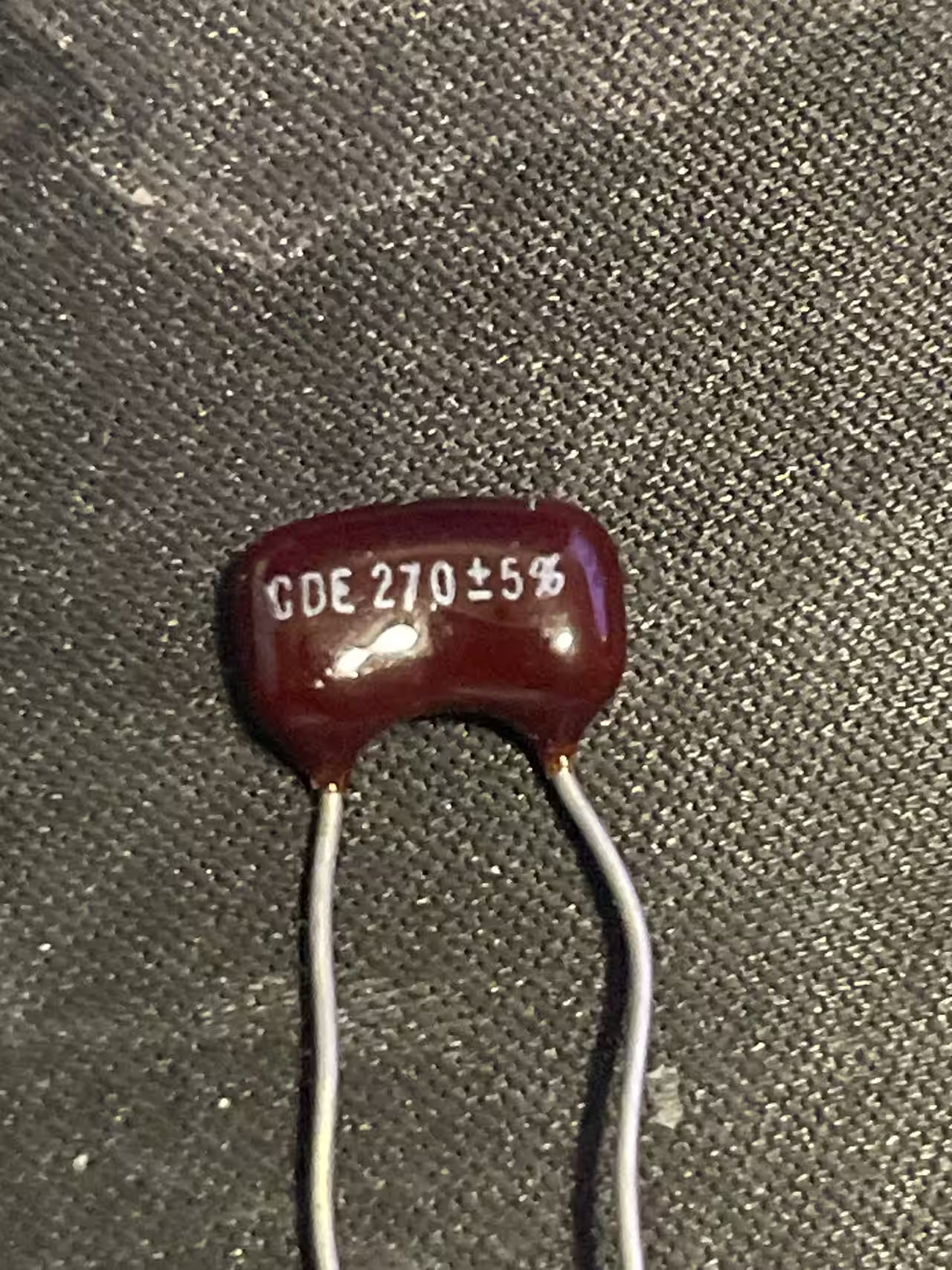
- 2 photos
Never used. The original pack has been opened, or the quantity was split off a full reel or tube. Leads are original and unclipped.
New old stock, open stock on the grading scaleSend the quantity you need. You get a quote back with shipping before anything is charged.
Video
Filmed on the bench. Sound is stripped from product clips.
- 0:08
Specifications
| Specification | Value |
|---|---|
| Identification | |
| Part number | SABZ8E6A |
| Manufacturer | Cornell Dubilier |
| Condition | New old stock, open stock |
| Date code | Not recorded |
| Package | Moulded rectangular mica case, radial leads |
| Country of origin | Not recorded |
| Family | Not recorded |
| Stock number | SABZ8E6A |
| Overview | |
| Type | Moulded mica capacitor |
| Suggested use | Tuned circuits and timing where a close tolerance matters and the working voltage is modest |
| Electrical | |
| Capacitance | 270 pF, printed on the body |
| Tolerance | Plus or minus 5 percent, printed on the body |
| Polarity | None. Mica capacitors are not polarised |
| Not established | |
| DC voltage rating | Not established. No voltage appears on either face |
| Characteristic | Not established. No characteristic letter is printed |
| Part number | Not established. The body carries a maker's name and a value, not a type number |
| Markings as read | |
| Marking, face 1 | CDE 270 plus or minus 5 percent |
| Marking, face 2 | CDE and a repeated tolerance mark, no voltage |
| Provenance | |
| Manufacturer | Cornell Dubilier, from the CDE mark |
| Quantity offered | One piece |
| Condition | New old stock, unused, case unchipped and leads unsoldered |
| Basis of identification | The printed maker mark, value and tolerance only |
| Physical | |
| Lead style | Radial, both leads from the same edge |
| Body | Moulded rectangular case, deep reddish brown |
About this part
A Cornell Dubilier moulded mica capacitor marked CDE, 270, plus or minus 5 percent. New old stock, unused. What is not on it is a voltage rating, and since that is the one thing a buyer will want to know, it is worth being straight about at the top rather than burying it.
Both faces of this capacitor have been examined and neither carries a voltage. That is not unusual for moulded micas of this period: a great many were marked with value and tolerance only, on the reasonable assumption that anyone fitting one knew what family it came from and therefore what it would stand. The information was in the catalogue rather than on the part. Seventy years later the catalogue is harder to come by than the capacitor.
What that means practically is manageable rather than alarming. Moulded micas of this size were commonly rated at 300 or 500 volts, and mica as a dielectric has a very high intrinsic breakdown strength, so a part like this is not a fragile thing. But we are not going to print a number we cannot read, and you should not assume one either. If the circuit puts more than a hundred volts or so across it, establish the rating first.
Cornell Dubilier are one of the enduring names in American capacitors, founded in 1910 and still trading, and their mica work was the mainstay of radio and instrumentation for decades.
Questions about this part
Why does this capacitor have no voltage rating?
Because it was never printed on it. Many moulded micas of this period carried value and tolerance and nothing else, on the assumption that the person fitting one knew which catalogue family it came from and therefore what it was rated at. The rating lived in the catalogue rather than on the part. We have examined both faces and there is no voltage, so we have left the field empty rather than borrow a number from a similar looking part.
So how do I decide whether it is safe in my circuit?
Work out what the circuit actually applies. Moulded micas of this size were most commonly rated at 300 or 500 volts DC, and mica has a very high intrinsic breakdown strength, so this is not a delicate component. But an unread rating is an unread rating. If your application puts more than a hundred volts or so across it, source the rating from a Cornell Dubilier catalogue of the era or choose a part whose rating you can read.
Is this the same as the El-Menco 270 pF also listed here?
Same value and same tolerance, different maker, and one important difference in what you know about it. The El-Menco carries a full military part number and its voltage rating in plain language on the body. This one carries a maker mark and a value. If you want a documented part, buy that one. If you want a Cornell Dubilier specifically, or you are matching a pair and only need the value, this one is cheaper for exactly that reason.
Who are Cornell Dubilier?
One of the oldest names in American capacitors, founded in 1910 and still trading today. Their mica capacitors were a mainstay of radio, television and instrumentation for decades, and CDE marked parts turn up in almost any American equipment of the valve era. The company outlived most of its competitors in the mica business.
What does 5 percent tolerance buy me in practice?
It is the reason to choose mica over ceramic. A 5 percent part in a tuned circuit places the resonant frequency within a predictable band, so an alignment holds. It also means two capacitors from the same batch are likely to be close to each other, which matters when you are matching a pair for a filter or a balanced stage. For bypass duty it is irrelevant and a ceramic would do.
Does mica degrade in storage?
No, and that is the whole argument for buying old mica. The dielectric is a mineral crystal. Nothing dries out, nothing needs reforming and nothing perishes. The known long term failure mode is silver migration across the dielectric under sustained voltage and humidity, and that is a service phenomenon, not a shelf one. An unused capacitor has not begun it.
What condition is this one in?
New old stock, open stock, never fitted. The moulded case is intact with no chips or cracks, the printing is legible, and both leads are unsoldered and free of the kinks that a previous installation leaves. The photographs show the actual capacitor.