
Philco
Philco 2N2087 NPN Epitaxial Mesa Transistor, TO-5, Core Driver
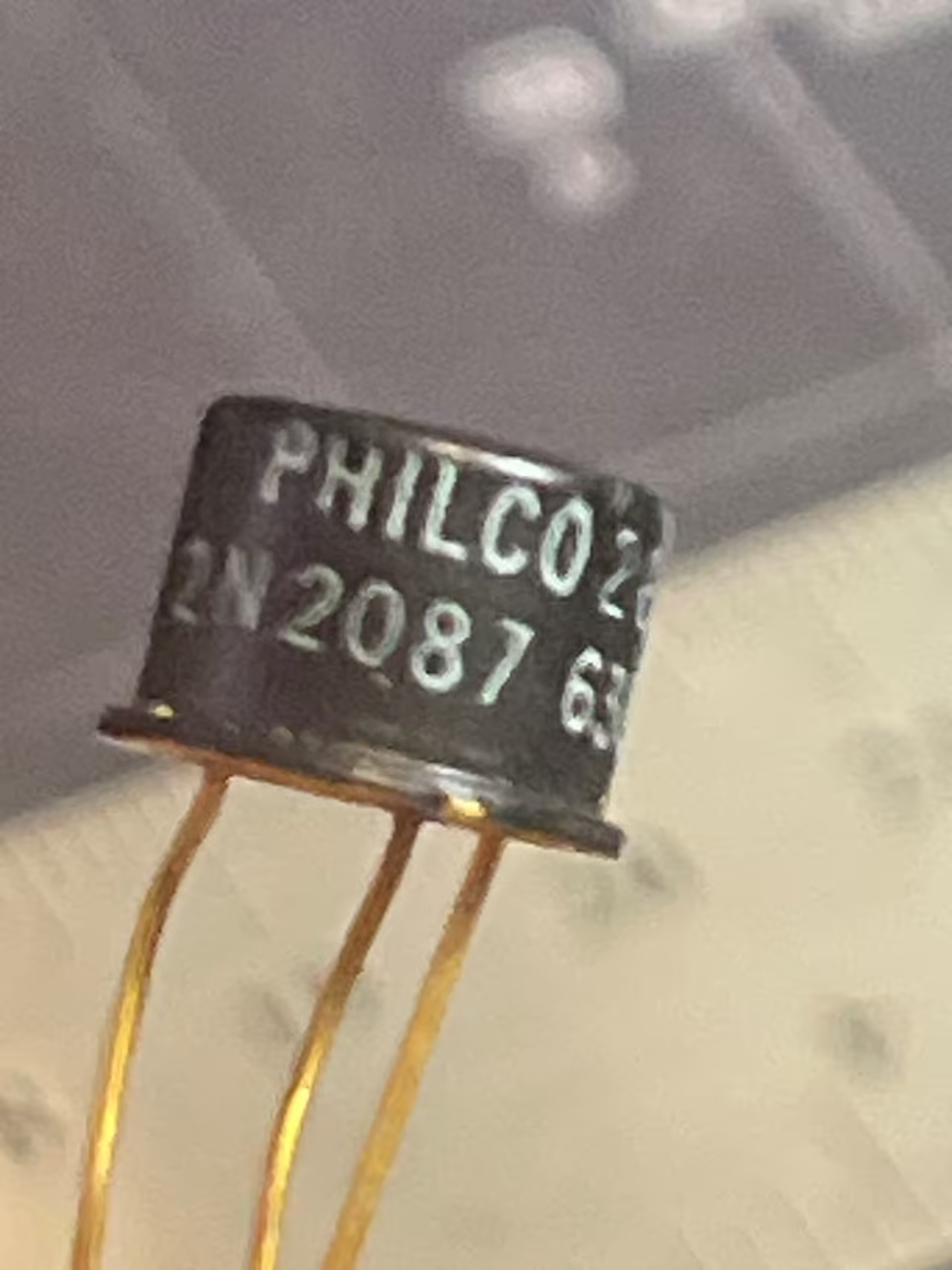
- 3 photos
Never used. The original pack has been opened, or the quantity was split off a full reel or tube. Leads are original and unclipped.
New old stock, open stock on the grading scaleSend the quantity you need. You get a quote back with shipping before anything is charged.
Video
Filmed on the bench. Sound is stripped from product clips.
- 0:17
Specifications
| Specification | Value |
|---|---|
| Identification | |
| Part number | 2N2087 |
| Manufacturer | Philco |
| Condition | New old stock, open stock |
| Date code | 6303 0260 |
| Package | TO-5 hermetically sealed metal can |
| Country of origin | Not recorded |
| Family | 2N2087 |
| Stock number | R3YV5NED |
| Overview | |
| Manufacturer part number | 2N2087 |
| Manufacturer | Philco |
| Device type | NPN silicon epitaxial mesa transistor |
| Sold for | Memory core and line driving, servo and airborne control |
| Electrical | |
| Collector base voltage | 120 V |
| Collector emitter voltage | 80 V with the base returned |
| Collector current | 500 mA |
| Dissipation | 2 W case mounted, 0.6 W in free air |
| Transition frequency | 150 MHz minimum |
| Saturation voltage | About 0.5 V maximum |
| Construction | |
| Package | TO-5 hermetically sealed metal can |
| Condition | |
| Condition | Vintage old stock. Never installed, never soldered |
| Testing | Sold untested. Ask and the exact piece going in the envelope is metered first |
About this part
Core driver is a job title that has not existed for fifty years, and it is what this part was sold for. Before semiconductor memory, a computer stored bits in magnetic cores threaded on wires, and writing one meant slamming enough current through a wire to flip the core's magnetisation. That needs a transistor that will hold off a high voltage, switch fast, and survive doing it thousands of times a second. Philco introduced the 2N2087 for exactly that, and advertised it for memory plane drive in 1961 and 1962.
The figures follow from the job: 120 volts collector to base, 80 volts collector to emitter with the base returned, half an amp of collector current, two watts case mounted, and a transition frequency of at least 150 MHz with a saturation voltage around half a volt. High voltage and fast, which is an awkward combination and why an epitaxial mesa device was needed to get it.
The same qualities made it useful in airborne controls, servo amplifiers and power supplies, which is where most of them actually ended up. The can carries 2N2087 with 6303 and 0260 beside it, which look like production and date coding rather than separate part numbers. Ordinary oxidation and some fading. Untested, sold individually.
Questions about this part
What is a core driver?
Before semiconductor memory, computers stored bits in magnetic cores threaded on wires, and writing one meant pushing enough current through a wire to flip the core's magnetisation. The transistor doing that has to hold off a high voltage, switch fast and survive repeating it thousands of times a second. Philco built and advertised the 2N2087 for precisely that.
Why does it need to be an epitaxial mesa device?
Because high voltage and high speed pull against each other. Getting 120 volts of standoff together with a 150 MHz transition frequency and a half volt saturation was not achievable with the ordinary constructions of the day, and the epitaxial mesa process is what made the combination possible.
Are the extra numbers on the can part numbers?
No. 6303 and 0260 read as production and date coding. They are quoted exactly as they appear and not decoded, since a confident date from an unnamed scheme would be a guess.
Is it useful for anything other than memory?
It was sold into airborne controls, servo amplifiers, power supplies and automation, which is where most of them actually went. Anywhere that wanted a fast switch with real voltage headroom in a small can.