
ETCO
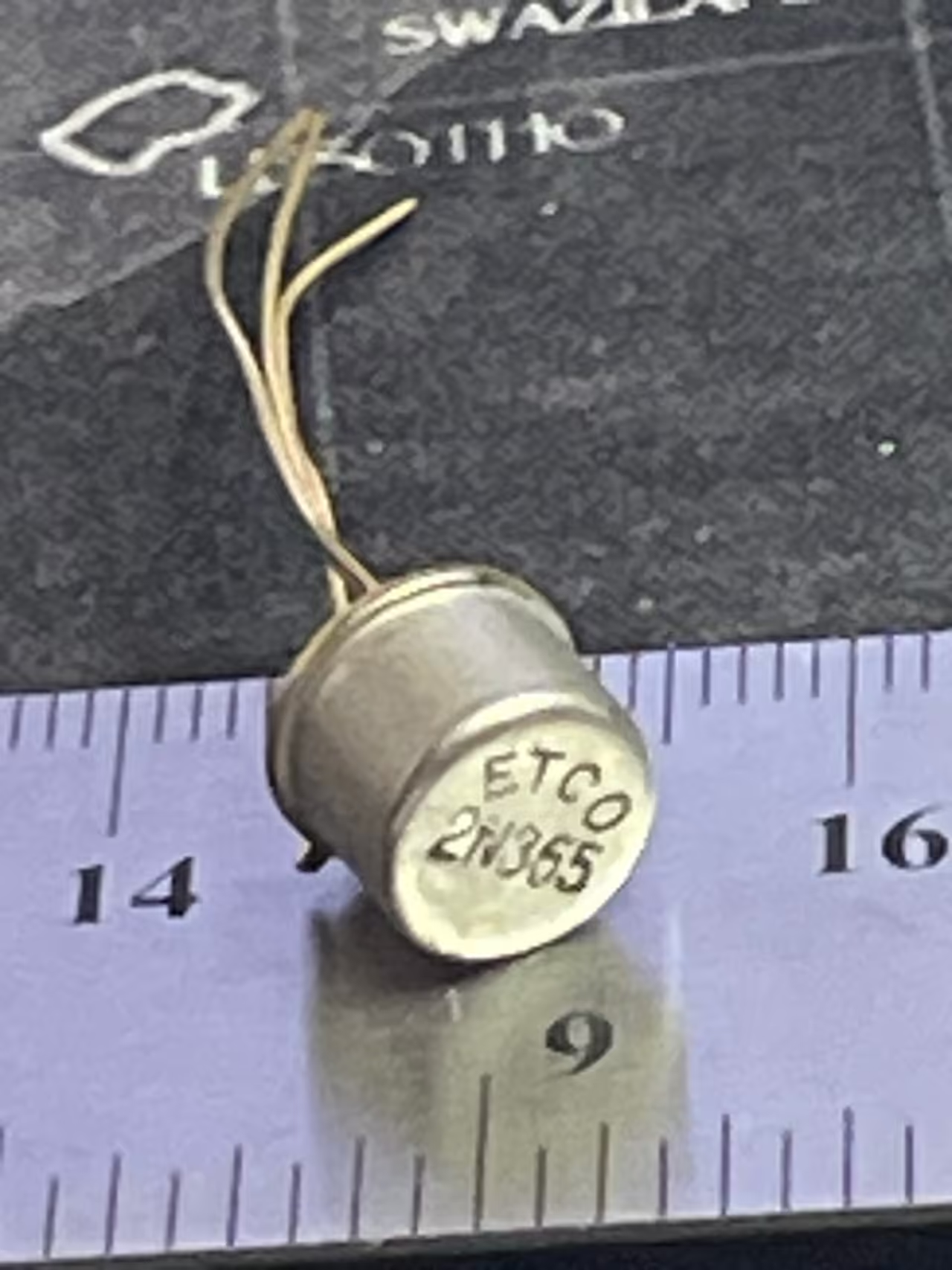
ETCO 2N365 NPN Germanium Transistor, Metal Can, NOS
- 3 photos
Never used. The original pack has been opened, or the quantity was split off a full reel or tube. Leads are original and unclipped.
New old stock, open stock on the grading scaleSend the quantity you need. You get a quote back with shipping before anything is charged.
Video
Filmed on the bench. Sound is stripped from product clips.
- 0:12
Specifications
| Specification | Value |
|---|---|
| Identification | |
| Part number | 2N365 |
| Manufacturer | ETCO |
| Condition | New old stock, open stock |
| Date code | Not recorded |
| Package | Three lead metal can |
| Country of origin | Not recorded |
| Family | 2N365 |
| Stock number | DE22SXE9 |
| Overview | |
| Manufacturer part number | 2N365 |
| Manufacturer | ETCO |
| Electrical | |
| Polarity and material | NPN germanium |
| Class | Early general purpose amplifier |
| Construction | |
| Package | Three lead metal can |
| Condition | |
| On the shelf | Eleven |
| Condition | New old stock, open stock. Never installed, never soldered |
| Testing | Sold untested. Ask and the exact piece going in the envelope is metered first |
About this part
An NPN germanium transistor, which is the less common half of a family most people meet as PNP. Nearly all early germanium work was PNP, so circuits that wanted the opposite polarity, complementary output stages in particular, had a much shorter list of parts to choose from. That is what makes an NPN germanium worth keeping on a shelf: when a restoration needs one there is rarely a modern equivalent that behaves the same way.
What germanium does differently is mostly about the junction. It drops around 0.2 to 0.3 volts where silicon drops 0.6 to 0.7, it leaks appreciably at room temperature and much more as it warms, and its gain moves with temperature. In a circuit designed around those properties the behaviour is the point. Dropping a silicon part into the same socket changes the bias and usually the sound or the switching threshold with it.
Eleven are on the shelf, the largest germanium count in this drawer, so this is the listing to come to if you need several rather than one. The cans show the oxidation, discolouration and storage marking normal for the era. Sold individually and sold untested, which for germanium is the honest position: leakage is the parameter that matters and it needs measuring at temperature, not at a bench in passing.
Questions about this part
Why does an NPN germanium matter?
Because most germanium devices were PNP, so any circuit needing the opposite polarity had far fewer parts to pick from. Complementary output stages are the usual case. When a restoration calls for an NPN germanium there is often no modern part that behaves closely enough to substitute.
How does germanium behave differently from silicon?
The junction drops roughly 0.2 to 0.3 volts against silicon's 0.6 to 0.7, it leaks noticeably at room temperature and much more when warm, and its gain shifts with temperature. Circuits of the era were designed around exactly that. Fitting silicon in the same place changes the bias point and usually the behaviour you were trying to preserve.
Can you tell me the leakage or gain of a specific piece?
Ask and we will meter the exact one going in the envelope. Leakage is the parameter that decides whether an old germanium part is usable, and it is worth measuring rather than assuming. What we will not do is publish a number for eleven pieces as though they were identical.
Are all eleven the same?
They came from one lot and all are marked 2N365. Expect cosmetic variation in oxidation and discolouration across the group, which is normal for germanium cans of this age and does not predict the electrical condition.