
Sprague
Sprague 150D Solid Tantalum Capacitor, 0.01uF 20V, Axial, Polarity Marked
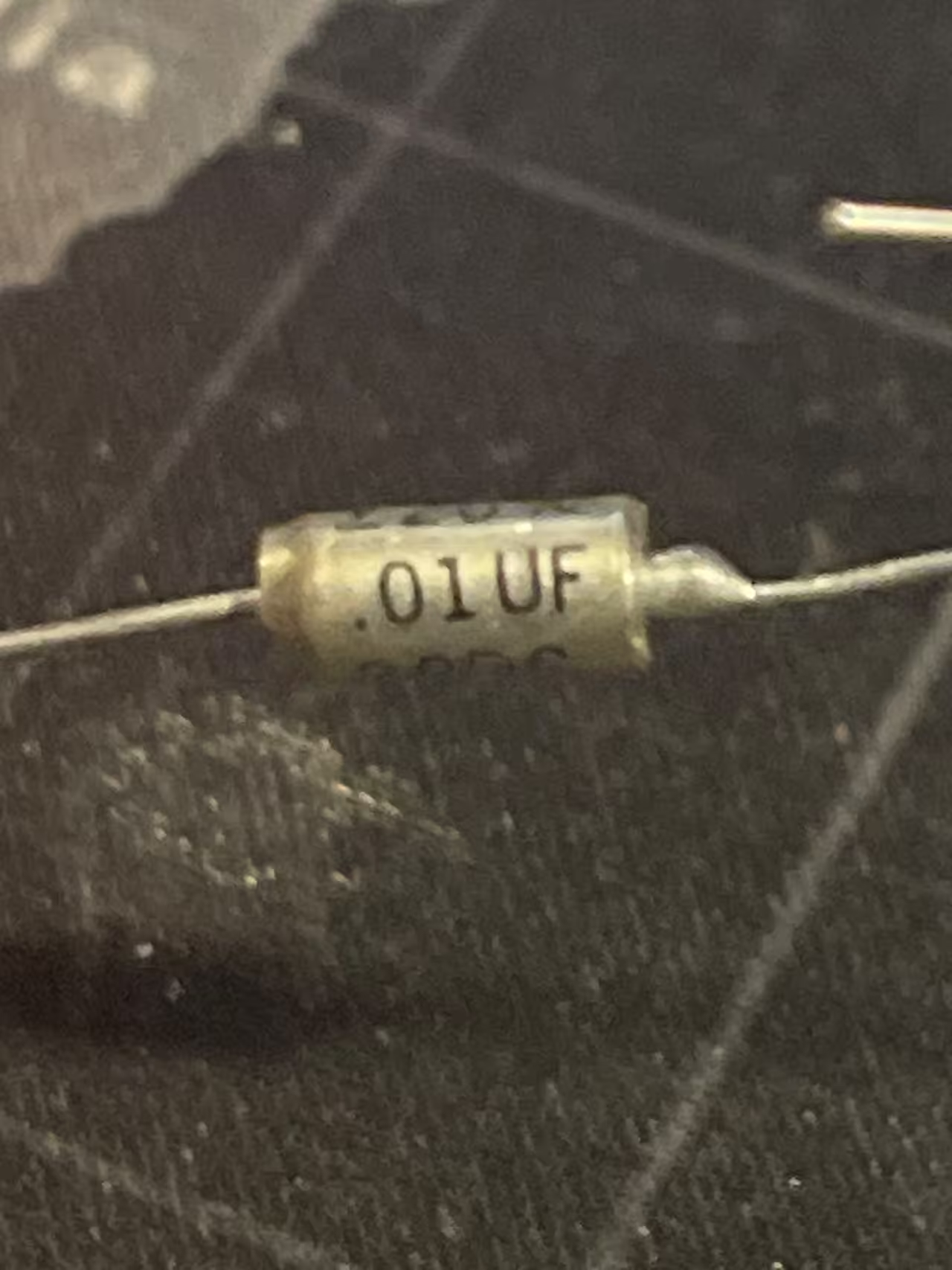
- 4 photos
Never used. The original pack has been opened, or the quantity was split off a full reel or tube. Leads are original and unclipped.
New old stock, open stock on the grading scaleSend the quantity you need. You get a quote back with shipping before anything is charged.
Video
Filmed on the bench. Sound is stripped from product clips.
- 0:12
Specifications
| Specification | Value |
|---|---|
| Identification | |
| Part number | RHBRFP2W |
| Manufacturer | Sprague |
| Condition | New old stock, open stock |
| Date code | Not recorded |
| Package | Axial leaded, hermetically sealed can under a cream insulating sleeve |
| Country of origin | Not recorded |
| Family | 150D |
| Stock number | RHBRFP2W |
| Markings as read | |
| Marking, value face, upper line | .01UF |
| Marking, value face, lower line | 20DC, resolved at nine times magnification as four glyphs, 2 and 0 then D and C |
| Marking, type face | 150D, followed by a plus mark set toward one lead |
| Logo on the type face | A small rounded glyph above the 150D line, not resolved in the photographs |
| Other marks on the body | A digit 2 inside a printed circle and a five pointed solid star, side by side on the widest part of the body. A third line sits below them and is cut off by the curve of the body, not legible. Recorded as read, without interpretation. |
| Manufacturer name in words | None visible. The identification rests on the printed type designation, not on a brand name. |
| Identification | |
| Type designation | 150D |
| Series | Sprague Type 150D, solid electrolyte TANTALEX, hermetically sealed, axial lead |
| Basis of identification | The printed 150D designation, the polarity mark and a 20 VDC rating that appears in the series voltage list. Sleeve, case size and marking set all agree with the datasheet. |
| Military equivalent of the series | M39003/01, style CSR13, qualified to MIL-PRF-39003/1 |
| Electrical | |
| Capacitance | 0.01microfarad |
| Capacitance, alternative units | 10 nF, 10000 pF |
| DC voltage rating | 20VDC |
| Surge and derated ratings for the series | 26 V surge at +85 C. At +125 C, 13 VDC working and 16 V surge. |
| Polarity | Polarised. The lead nearer the plus mark is the positive lead. |
| Not established | |
| Tolerance | Not established. No tolerance letter is legible on the body. |
| Physical | |
| Construction and body | Hermetically sealed metal case under a shrink fitted plastic film sleeve, cream to pale tan, with solid tinned nickel axial leads, about the size of a quarter watt resistor |
About this part
Every marking on this part agrees with the others. One face reads.01UF above 20DC. The other carries 150D with a plus mark toward one lead, under a small logo that will not resolve. The voltage line was read at magnification: four glyphs, a 2 and a 0, then D and C. So this is a Sprague Type 150D, the hermetically sealed solid electrolyte TANTALEX axial tantalum, 0.01 uF at 20 volts DC, polarised.
The cream body is the sleeve, not the can. A 150D is a sealed metal case, and the insulated version carries a shrink fitted plastic film sleeve that laps over the ends, style number 2 in Sprague's ordering code. The size matches case code A, 3.43 mm across by 7.26 mm long over that sleeve. One thing to expect: the current Vishay ratings table starts at 0.027 uF, so you will not find this value on a modern datasheet, though the older Sprague range reached down to about 0.0047 uF.
Polarity is what to get right. The lead nearer the plus is positive, and that is the opposite of the aluminium electrolytic convention, where the stripe marks the negative end. Reverse a solid tantalum and it fails short rather than open, often hot enough to burn. Measure capacitance and leakage before trusting a fifty year old part on a live rail, run it at about half its rating as is usual for solid tantalum, and derate further above 85 C.
Questions about this part
Which lead is positive?
The lead nearer the plus mark. Read that twice if you work mostly with aluminium electrolytics, because the conventions are opposite: on an aluminium can the stripe marks the negative end, while on a tantalum the plus or the bar marks the positive one. Getting it backwards is the most common way these parts are destroyed.
What happens if I fit it the wrong way round?
A solid tantalum has almost no reverse tolerance. Reversed, it goes low resistance, and because it fails short rather than open it keeps conducting, which on a low impedance supply means heat, smoke and sometimes flame. Fuse or current limit the rail the first time you power up a board you are unsure of.
How certain is the identification?
As certain as markings can make it. The type designation and the polarity mark are printed on the body, 150D is Sprague's solid tantalum series, and the 20 VDC reading is one of the standard ratings in that series. Construction, sleeve, case size and the marking set all agree with the datasheet. The only thing not read off the part is the maker's name, since the logo does not resolve.
Why is the body cream if the case is metal?
Because you are looking at the sleeve, not the can. The 150D is a hermetically sealed metal case, and the insulated version carries a shrink fitted plastic film sleeve that laps over the ends of the body. That is style number 2 in Sprague's ordering code, and it is why these read as cream or pale beige rather than bare tin.
Is 0.01 uF not a very small value for a tantalum?
It is at the bottom of the range, and it is worth knowing why you will not find it on a current datasheet. The 150D historically reached down to about 0.0047 uF, and catalogue parts in the 150D103 form exist, but the modern Vishay ratings table stops at 0.027 uF. This is a stock item from an older catalogue rather than anything anomalous.
What should I check before fitting it?
The ordinary diligence for a polarised part of this age. Measure the capacitance, then the leakage, which is the reading that finds a tantalum stored damp or left reverse biased. In service, run it at about half its rating, which is the usual practice for solid tantalum, and keep some series impedance in a low resistance supply. The series is specified from minus 55 C to plus 125 C, with voltage derating required above plus 85 C.
Could I use a modern capacitor instead?
For most purposes yes, and it will be cheaper. A 0.01 uF X7R or C0G ceramic is not polarised, cannot fail this way and is better behaved on nearly every measure. Reach for the tantalum when you are restoring a board to its original parts, or when the circuit was designed around this part's particular impedance behaviour.