
Magnecraft
Magnecraft 70S2-04-C-12-N Solid State Relay, 12 A at 240 V AC, 3 to 30 V DC Control
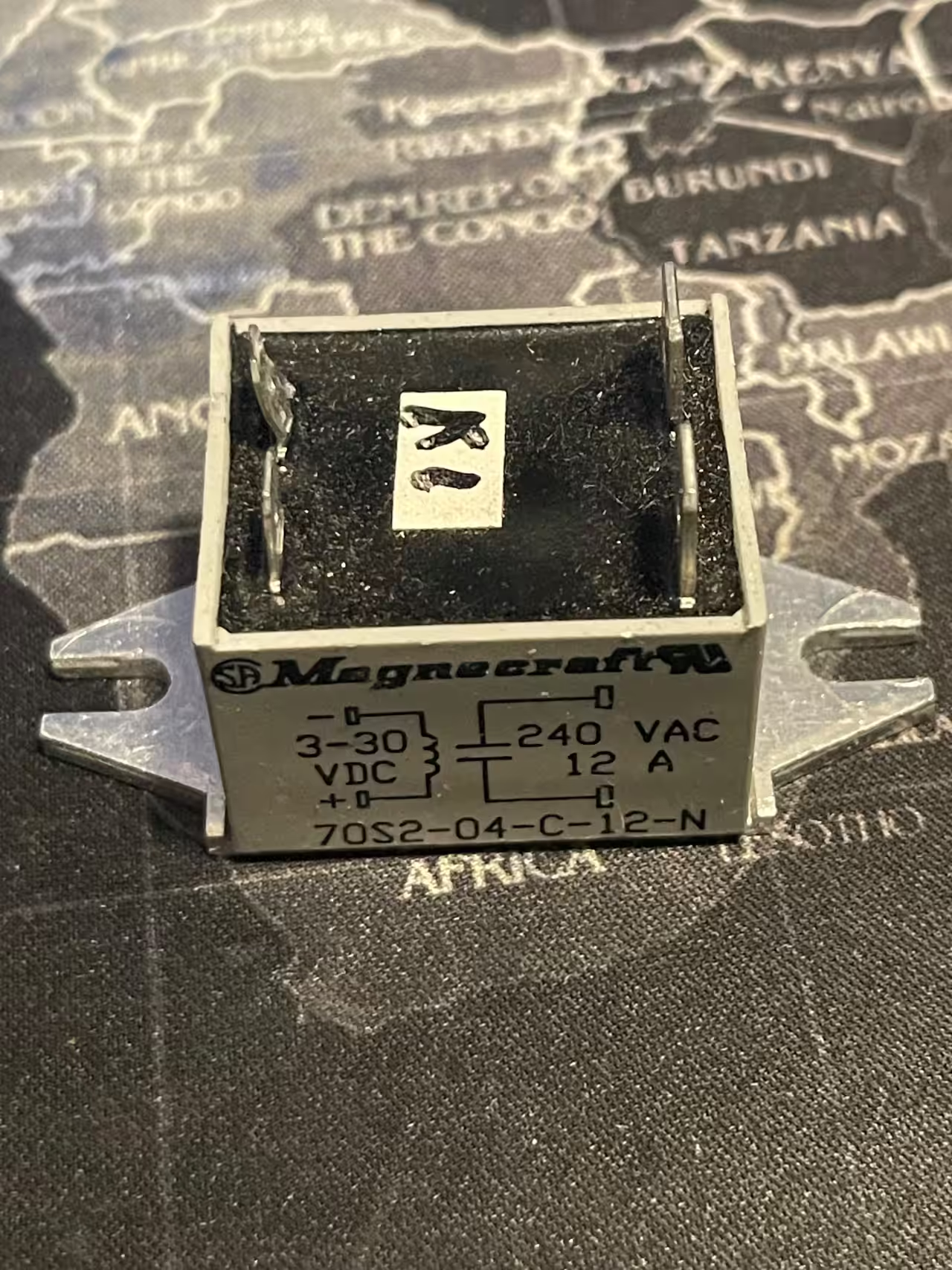
- 3 photos
Never used. The original pack has been opened, or the quantity was split off a full reel or tube. Leads are original and unclipped.
New old stock, open stock on the grading scaleSend the quantity you need. You get a quote back with shipping before anything is charged.
Video
Filmed on the bench. Sound is stripped from product clips.
- 0:14
Specifications
| Specification | Value |
|---|---|
| Identification | |
| Part number | 70S2-04-C-12-N |
| Manufacturer | Magnecraft |
| Condition | New old stock, open stock |
| Date code | 0109 |
| Package | Panel mount, metal case with slotted mounting flange, blade terminals |
| Country of origin | Not recorded |
| Family | 70S2 |
| Stock number | S863R9MV |
| Overview | |
| Type | Solid state relay, optically coupled |
| Manufacturer part number | 70S2-04-C-12-N |
| Series | Magnecraft 70S2, panel mount miniature |
| Contact arrangement | SPST normally open |
| Output | |
| Load current | 12 A |
| Load voltage, marked on case | 240 V AC |
| Load voltage, catalogue range | 24 to 280 V AC |
| Transient protection | Internal snubber across the output |
| Input | |
| Control voltage | 3 to 30 V DC |
| Control polarity | Marked plus and minus on the case, polarity sensitive |
| Isolation | Optical, input to output |
| Physical | |
| Terminals | Blade terminals on the top face |
| Mounting | Slotted flange at each end for panel mounting |
| Case | Metal, potted, printed schematic on the face |
| Compliance | |
| Approvals | CSA mark on the label |
| Provenance | |
| Lot code | 0109, printed on the side of the case |
| Condition | New old stock, unused, no solder or wiring marks |
About this part
A Magnecraft 70S2-04-C-12-N panel mount solid state relay, rated 12 A at 240 V AC and switched by a 3 to 30 V DC control input. New old stock, never wired in. Lot code 0109 on the case.
This is a solid state relay and not a coil and armature type, which is the first thing to be clear about because the two behave nothing alike. The label carries a schematic showing a polarity marked DC input on one side and an isolated AC output on the other. Inside, an LED drives a photosensitive trigger which fires the output device, so there is no coil, no contact bounce, no arcing and nothing to wear out mechanically. Magnecraft rate the 70S2 series with an internal snubber across the output to protect it from mains transients.
Two consequences a buyer should know before designing it in. A solid state relay is never truly open: the output leaks a small current when it is off, so it cannot be used as a safety isolator and it will faintly light a neon or trickle current into a high impedance load. And it dissipates real heat when on, roughly a watt per amp through the output device, so at anything near 12 A it wants metal to sink into rather than still air.
The wide 3 to 30 V DC input range is what makes these useful. One part takes a 5 V logic output, a 12 V supply or a 24 V industrial rail with no change, and the input is polarity marked so it has to be wired the right way round.
The case is a metal box with a slotted mounting flange at each end and blade terminals on top. It has a CSA mark. Nothing has been cut, bent or soldered.
Questions about this part
Is this an ordinary relay with a coil and contacts?
No, and the difference matters. This is a solid state relay. There is no coil and there are no moving contacts. An LED inside drives a photosensitive trigger that switches the output device, so nothing bounces, nothing arcs and nothing wears out mechanically. The clue on the case is the 3 to 30 V DC input range: a coil is specified at one nominal voltage with a narrow band, while a wide DC range with a polarity marking is how an optically isolated input is specified.
Can I use it to isolate a circuit for safety?
No. A solid state relay is never fully open. The output passes a small leakage current when it is switched off, enough to light a neon indicator faintly or to trickle current into a high impedance load. If you need a guaranteed break, use a mechanical contact or a disconnect designed for the job. This is a switching device, not an isolator.
Does it need a heatsink?
At anything approaching its rating, yes. The output device drops roughly a volt while conducting, so it turns about a watt into heat for every amp passing through it. At 12 A that is a meaningful amount of heat for a small metal case in still air. Mount it to a panel that can carry the heat away, give it airflow, and derate it if the enclosure runs warm.
What does the 3 to 30 V DC range actually buy me?
One part covers most control voltages you are likely to have. A 5 V logic output, a 12 V supply and a 24 V industrial rail all drive it without a change of part or a dropper resistor. The input is polarity marked, so it has to be wired the right way round, and the control current is small, so an ordinary logic output can drive it directly.
What do the parts of the number mean?
70S2 is the Magnecraft panel mount miniature solid state series. The 12 is the load current in amps. The final N denotes the blade terminal version; the same relay is also catalogued with screw terminals and in a printed circuit mount form, so check that the terminal style matches your fitting before ordering a replacement.
Does a solid state relay age on the shelf?
Far less than a mechanical relay does. There are no contacts to oxidise and no spring to take a set. The parts that age are the optical coupler, which loses a little efficiency over decades, and the snubber components. Neither is a storage failure in the way a dried out electrolytic is. A relay that has never been powered has also never taken a switching transient, which is what usually ends the life of one of these.
What condition is this one in?
New old stock, open stock, never installed. The terminals are clean and unsoldered, the mounting flanges are unmarked and the printed label is fully legible. The photographs on this listing are of the actual relay you would receive.